

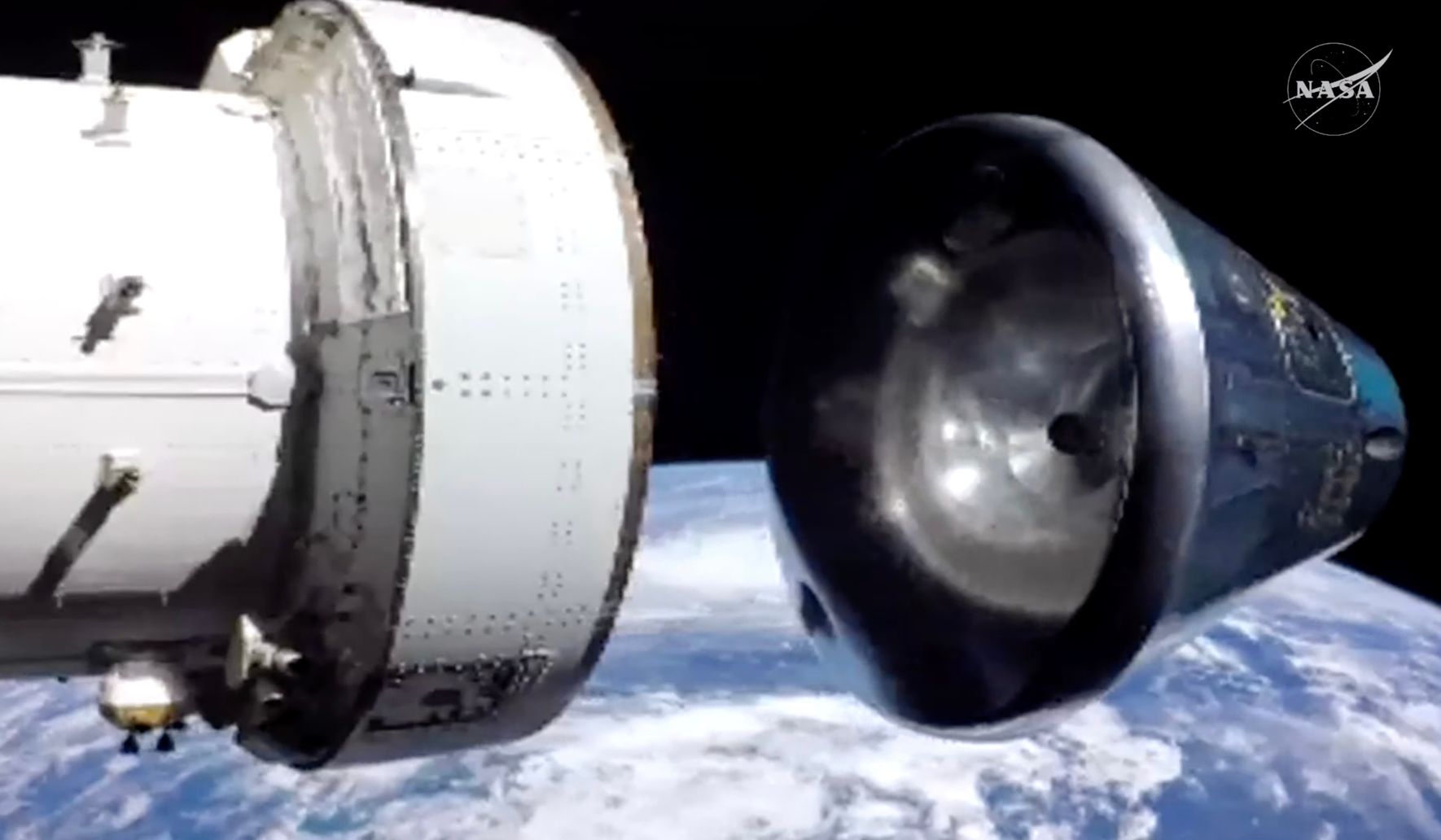
Artemis II made a high-stakes return to Earth this week, completing a historic crewed trip around the Moon with a dramatic splashdown that closed a chapter in human spaceflight more than five decades after the last lunar mission.
Artemis II’s astronauts returned from the moon with a dramatic splashdown in the Pacific on Friday to close out humanity’s first lunar voyage in more than a half-century. The capsule pierced the atmosphere and slowed for final descent before striking the ocean surface under parachutes, a textbook conclusion to a mission that tested systems and crew performance in deep space. From reentry heat to flotation checks, the final minutes were watched closely by engineers ashore and support teams at sea.
Recovery forces moved quickly after impact to secure the spacecraft and verify the crew’s health, following carefully rehearsed procedures designed to handle any contingency. Divers and deck crews stabilized the capsule while medical teams performed initial checks on the astronauts, looking for signs of reentry stress and fluid shifts. The goal was straightforward: get the crew safe and comfortable, then begin more detailed medical monitoring and data collection back on land.
Technically, this mission validated life-support systems, navigation accuracy, and radiation shielding for future longer stays near the Moon, and it provided a live rehearsal for Artemis missions that will include lunar surface operations. Engineers reviewed telemetry and crew feedback immediately to confirm that flight hardware performed within expected margins. These data sets are critical for tuning habitats, suits, and vehicles intended for sustained operations at lunar distance.
Public attention focused on the symbolic return: humans back from a lunar voyage after more than fifty years, reconnecting America and its partners with a kind of exploration that has been absent from headlines for decades. The splashdown evoked imagery from the Apollo era while signaling modern advances in systems integration, commercial partnerships, and mission planning. That blend of tradition and innovation framed much of the commentary around the mission’s end.
Beyond the spectacle, mission managers now face an intense period of review. Post-flight analysis will probe everything from structural margins and parachute performance to environmental control anomalies and software telemetry. Each anomaly, however small, will be cataloged and studied; the whole enterprise depends on iterative improvement and a steady cadence of lessons learned.
The crew themselves emerged as spokespeople for the program, describing the mission in candid terms and answering questions about life in transit, the view of Earth and Moon, and how training matched real-world stresses. Their perspectives are already shaping refinements to procedures and habitability features, giving engineers concrete user feedback rather than abstract design notes. That close loop between crew experience and technical response is essential as missions grow longer and more complex.
Looking ahead, the operational choreography of splashdown, recovery, and post-flight assessment will be sharpened for the next flights in the series, with adjustments to logistics, range safety, and medical planning. Each cycle tightens those processes so that subsequent missions can push farther with confidence, building toward eventual surface operations. For now, the successful return marks a clear milestone and a practical foundation for what comes next.
Even as congratulations poured in, agencies and private partners emphasized that this is a step, not an endpoint, in a renewed human presence around the Moon. The mission provided irreplaceable data, proved procedures under real conditions, and demonstrated that crews can complete complex tasks both en route to and returning from lunar distance. That combination of tested hardware and human performance sets the stage for the next phase of exploration and longer-duration missions to follow.

