

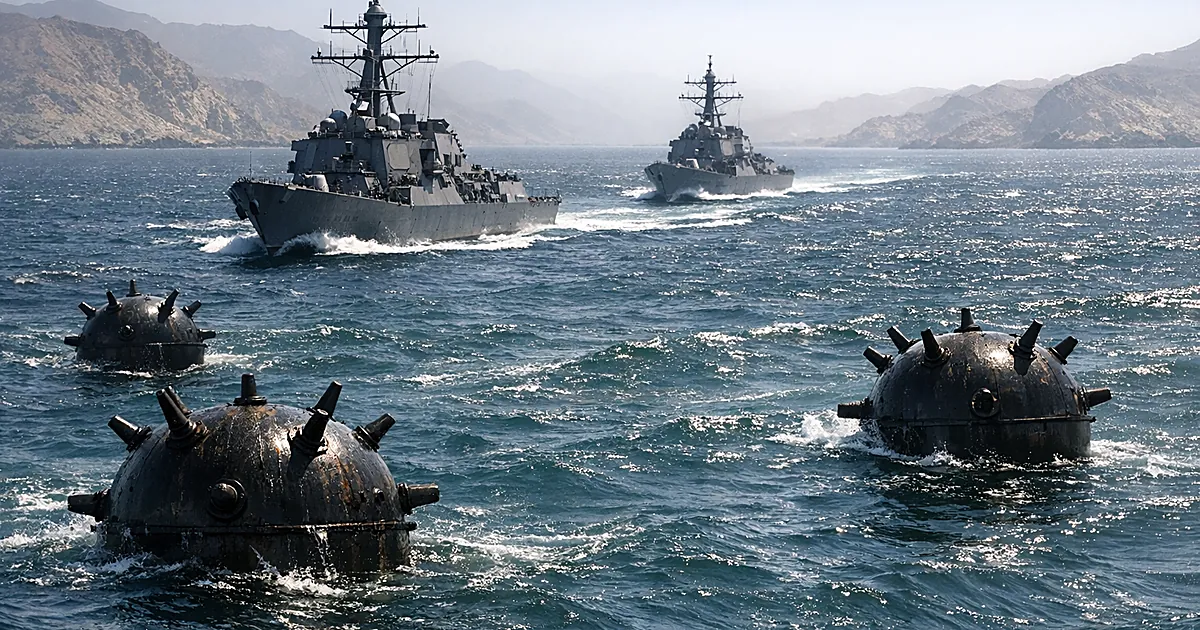
U.S. forces have started clearing mines from the Strait of Hormuz after sinking Iranian mine-laying vessels, while talks with Tehran proceed amid uncertainty.
U.S. Central Command announced that American naval forces have begun de-mining operations in the Strait of Hormuz, sending two guided-missile destroyers to open a safe channel through waters seeded with mines by Iran’s Islamic Revolutionary Guard Corps. The move aims to restore passage through a choke point that normally carries roughly one-fifth of the world’s daily oil flow. This is a clear operational step to get commerce moving again and to protect commercial shipping from a hostile regime’s gambit.
The two destroyers, the USS Frank E. Peterson and the USS Michael Murphy, started “setting conditions” for the mission on Saturday morning, according to military statements and press coverage. Both ships have prior experience operating in the Arabian Gulf during mine and counter-mine missions. Centcom commander Adm. Brad Cooper framed the effort as a turning point for global trade under direct pressure from Washington.
“Today, we began the process of establishing a new passage and we will share this safe pathway with the maritime industry soon to encourage the free flow of commerce.”
The announcement coincided with Vice President Vance sitting down with Iranian officials in Islamabad, the first direct contact between the two countries in decades. President Trump told NewsNation in a phone call that he had “no idea” how long the talks would last, underscoring the uncertainty at the negotiating table. The administration clearly paired hard military action with a diplomatic option to force a real choice from Tehran.
The mine-clearing operation followed what the defense secretary called the “most intense day” of U.S. strikes on Iranian targets so far in the eleven-day conflict. U.S. forces reportedly sank multiple Iranian mine-laying vessels that were part of a suspected plan to seal off the strait to commercial traffic. That loss of capability changed the immediate calculus and created the opening for clearance operations.
President Trump also asserted in public posts that “all 28 of their mine dropper boats are also lying at the bottom of the sea,” and that large portions of Iran’s naval and aerial capabilities had been degraded. He warned that if mines “are not removed forthwith, the Military consequences to Iran will be at a level never seen before.” He added: “If, on the other hand, they remove what may have been placed, it will be a giant step in the right direction.”
That combination of blunt military force and a diplomatic off-ramp is a hallmark of this administration’s approach. Rather than relying on extended concessions, officials pushed visible action first and then opened a channel for talks. It is a stance meant to reset deterrence and show Tehran that aggression carries immediate costs.
The economic fallout from a closed Strait of Hormuz was immediate and painful. Brent crude briefly hit levels near $118 per barrel and the national average for a gallon of gas climbed to around $4. Those are not abstract numbers; they translate into higher costs for families and businesses when a single hostile act chokes off a critical shipping lane.
Reopening the waterway matters because roughly one-fifth of global oil passes through that narrow channel every day. Letting a rogue power hold that route hostage invites real economic pain at home. The naval clearance effort is explicitly aimed at restoring free maritime movement, not merely signaling a presence.
Ships began to reenter the passage cautiously after a temporary halt in fighting was announced, but mines remained a real danger. The administration chose to act with available mine-countermeasure assets rather than wait for Iran to explain itself. That posture reflects a belief that effective diplomacy requires credible force in the background.
As the military moves, diplomacy continues in Islamabad, and the situation remains fragile. Asked whether Tehran was acting in good faith, the president said he had “no idea” and then said, “I’ll let you know that in a very short period of time. Won’t take long.” Those blunt lines capture a negotiating posture built on action, not wishful thinking.
The United States also emphasized its technological edge. The president noted the nation possesses the most “sophisticated mine equipment in the world,” a capability built over years and now deployed to reopen international waters. Deploying that gear sends a simple message: the U.S. will not wait for permission to secure global commerce.
Key details remain unknown, including the exact number of mines in the water and how long clearance will take, and the new corridor’s route has been withheld for security reasons. Tehran’s moves to impose new tolls on transiting oil vessels add another layer of unpredictability and may demand further decisions from Washington. For now, the administration is betting that strength first, then talk, gives America the best chance to protect shipping lanes and deter future coercion.

