

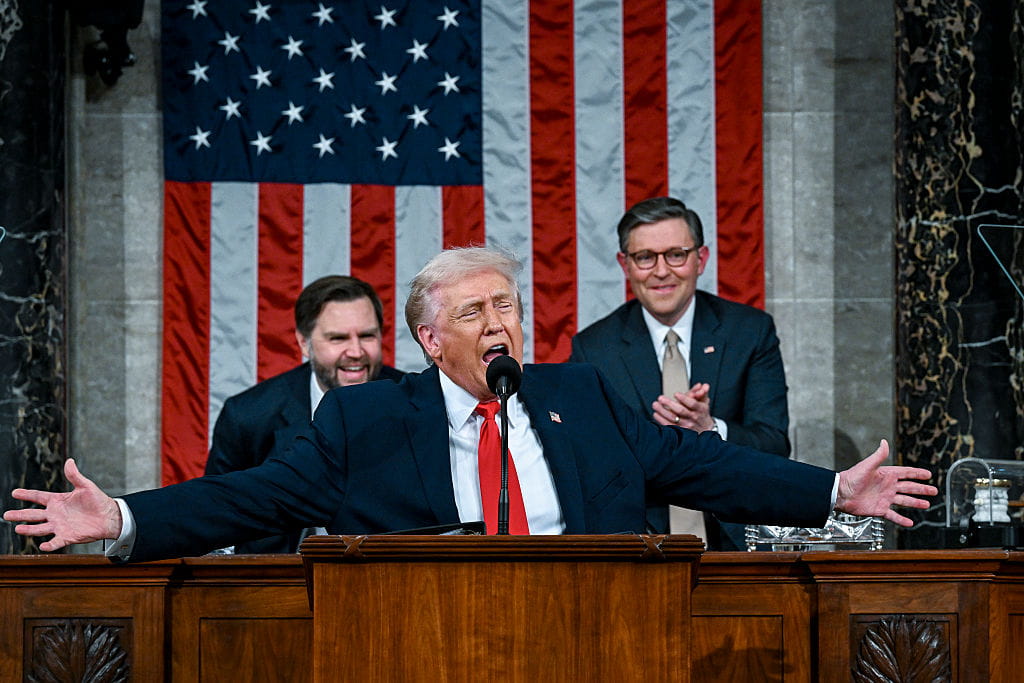
The record-long Feb. 24 State of the Union address and the intense Democratic backlash that followed make clear that President Donald Trump’s agenda and style are central to the political fight ahead.
The “record-long Feb. 24 State of the Union address” was part policy blueprint and part performance, and it landed in front of a nation that has learned to expect both. What followed from the opposition was not merely disagreement but a level of hostility that underscored how much is at stake. That combination turns a speech into a litmus test for the next phase of national politics.
Trump laid out policy priorities in plain language, focusing on borders, the economy, and national strength, and he did it in a way that energized his base. Republicans see that clarity as an advantage in a messy media environment where nuance gets lost. The left’s reaction, meanwhile, looked less like critique and more like political theater aimed at delegitimizing a rival.
The Democrats’ response before, during, and after the address revealed strategic choices that worry conservatives. Instead of engaging on policy specifics, many on the left doubled down on personal attacks and character arguments. That approach risks convincing swing voters that opposition to Trump has become reflexive rather than reasoned.
On policy, Trump articulated concrete goals that translate into legislative priorities for Republicans in Congress. Tax relief, energy independence, and stronger immigration enforcement were all front and center. Those are issues that have moved markets and communities, and they are the kind of measurable promises that voters can hold officials accountable for.
Culturally, the event highlighted a deeper divide over patriotism, free speech, and the role of institutions. Conservatives view the backlash as evidence that major institutions are out of step with everyday Americans. That perception fuels the argument that political change requires not only policy wins but also cultural pushback.
Strategically, the speech and the reaction sharpen campaign narratives on both sides. For Republicans, the message is straightforward: deliver results, defend the country, and push back against overreach. For Democrats, the choice seems to be doubling down on resistance and framing every Trump move as dangerous, which may energize the base but risks alienating undecided voters.
Media coverage played a predictable role in shaping public impressions, often framing the event through partisan lenses. Major outlets highlighted the theater and the outrage while sometimes downplaying the policy specifics. That selective focus benefits those who can turn controversy into narrative advantage more than it helps voters evaluate real outcomes.
Looking ahead, the consequence is clear: Trump’s personality and agenda will continue to dominate headlines and political debate. Republicans need to translate the momentum from the speech into practical organizing, policy wins, and disciplined messaging. Without that follow-through, the spectacle risks fading into noise rather than producing durable change.
The political landscape now hinges on whether voters reward tangible achievements or respond to the sustained campaign of opposition we just saw. Trump’s supporters believe the former will prevail because they have concrete examples of economic and security improvements. Critics on the left are betting the latter will mobilize enough fear and outrage to slow progress.
Regardless, the interplay of an assertive Republican agenda and an increasingly hostile opposition sets the terms for the next election cycle. Expect more rallies, sharper messaging, and intense battles over how to define patriotism and effective governance. Those fights will be messy, but they will also determine which vision for the country gains traction.

