

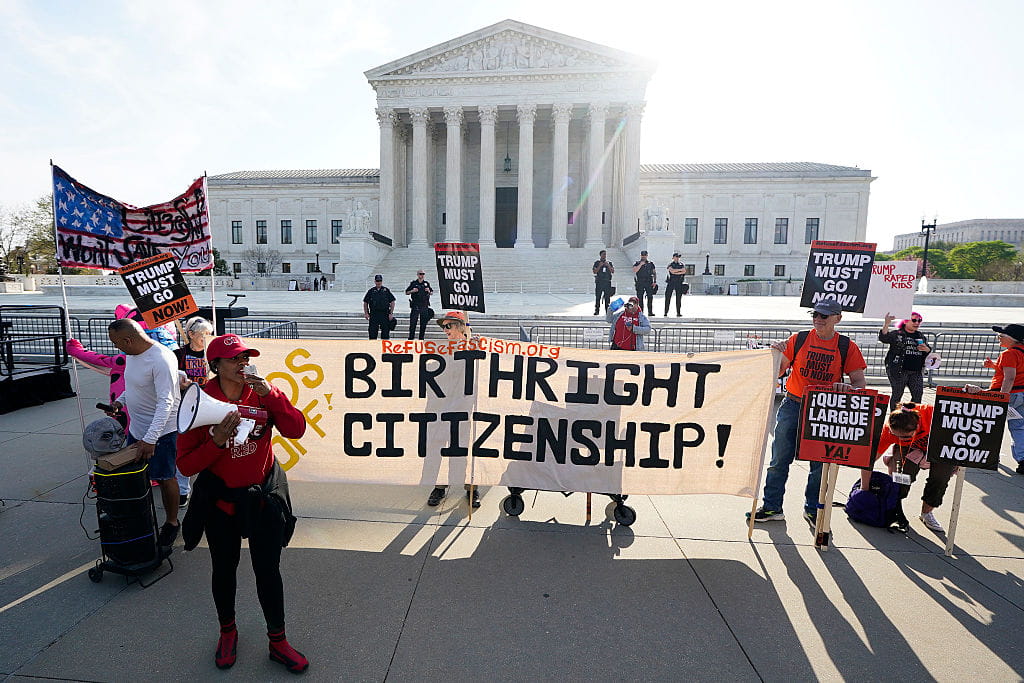
The Supreme Court heard oral argument on President Donald Trump’s executive order aimed at halting prospective birthright citizenship, with the president present in the courtroom and the justices offering no clear signals during the session.
The courtroom scene was striking: President Donald Trump sat in the front row as justices probed the legal and constitutional questions behind his executive order. Those arguments focused on whether an administration can alter a constitutional interpretation that has long governed citizenship by birth.
At the center is the long-debated phrase “subject to the jurisdiction thereof” in the Fourteenth Amendment, and the Republican argument that it does not automatically grant citizenship to every child born on U.S. soil. That view presses for a narrower, textual reading that aligns with an originalist approach to the Constitution.
Supporters of the president’s move say it addresses a policy problem created by mass illegal immigration and birth tourism, which they argue incentivize border crossings and strain public services. They see executive action as a necessary pause until Congress can provide a durable statutory framework that reflects current realities.
Opponents counter that the power to define citizenship belongs to the Constitution and to Congress, and that an executive order cannot unilaterally strip a class of people of a right historically recognized in American law. The debate therefore mixes constitutional interpretation with separation of powers concerns.
During oral argument, the justices tested both those legal and practical points, asking about precedents, congressional authority, and enforcement mechanics if such an order were upheld. Their questions suggested a court weighing doctrinal consistency against the political fallout of a sweeping change in citizenship rules.
A ruling in favor of the executive could invite additional litigation over how the government implements any change, including how citizenship is recorded, how visa and immigration systems respond, and how agencies define eligibility for benefits tied to status. Those logistical and administrative questions matter as much as the headline constitutional ruling.
Politically, the case is high stakes for Republicans who want to show action on border security and immigration control, and for opponents who warn of the human and diplomatic consequences of redefining citizenship. For conservatives, a win would be framed as restoring the Constitution’s original meaning and reasserting national sovereignty over membership.
The court’s decision will also affect the balance between judicial restraint and active constitutional correction of long-standing practices. Some justices appear inclined to defer to Congress or maintain settled interpretations, while others seem open to revisiting the premises behind birthright citizenship.
For voters and lawmakers, the case sharpens the choices ahead: whether to pursue legislative solutions or to rely on executive and judicial moves to reshape immigration policy. Whatever the outcome, implementation will require careful rulemaking, federal coordination, and likely further court battles as agencies and states test the new lines.
The presence of President Donald Trump in the courtroom underscored how legal arguments and political strategy now overlap in high-profile constitutional disputes. The justices left the hearing without revealing a clear path, so the nation waits for a decision that could have broad legal and policy effects.

