

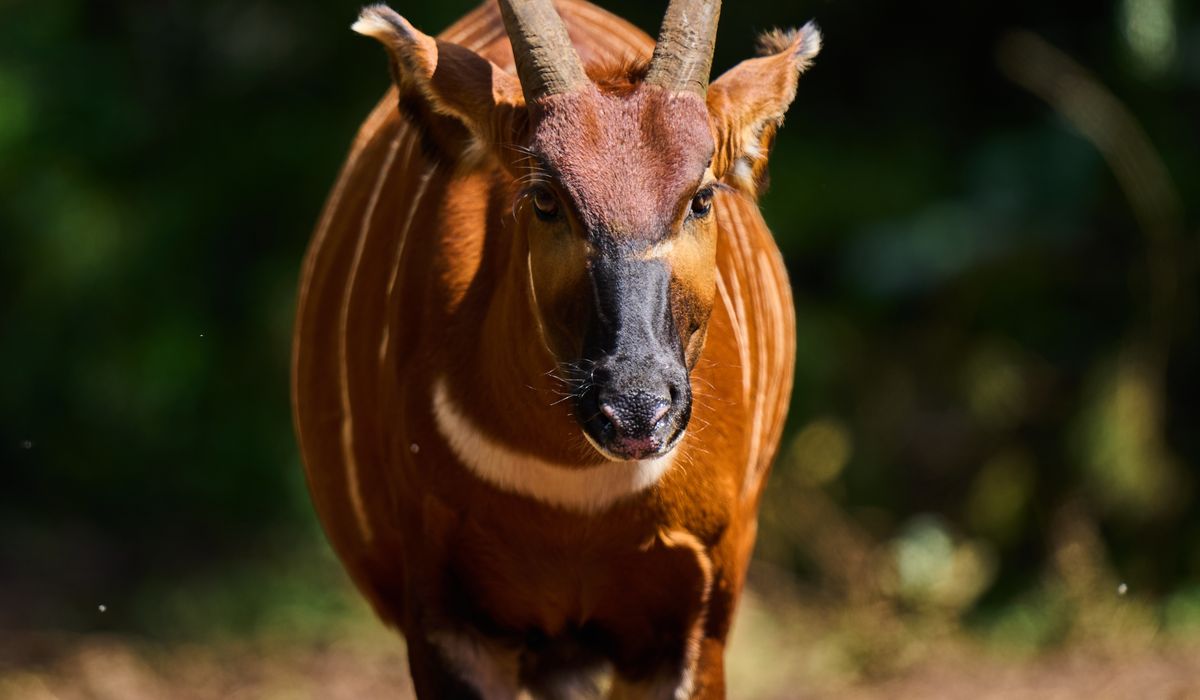
The mountain bongo remains one of Africa’s most elusive antelopes, known for its striking coat and deep vulnerability, and this article looks at its survival, the threats it faces, and the conservation work under way to keep it from disappearing.
The mountain bongo is a large, forest-dwelling antelope with a rich chestnut coat and white stripes that help it blend into undergrowth. Populations have dwindled across its range, making encounters rare and raising questions about long-term survival. Conservationists and researchers have been working to learn how best to protect this species and its shrinking habitat.
“The mountain bongo has become the ghost of the forest, hard to spot amid the dense shrubs due to its ability to camouflage.” That observation captures why standard wildlife surveys often miss these animals, pushing scientists to use more tailored monitoring methods. Camera traps, targeted field patrols, and local knowledge have become essential tools in locating remaining groups.
Habitat loss is among the biggest pressures facing the bongo, with forest clearing for agriculture and human settlement fragmenting once-contiguous ranges. Fragmentation isolates small populations and reduces genetic diversity, increasing the risk of inbreeding and disease. Protecting and, where possible, reconnecting forest patches is a central conservation priority.
Poaching remains a persistent threat despite legal protections and enforcement efforts, driven by demand for bushmeat and, in some cases, wildlife products. Anti-poaching patrols and community monitoring have shown localized success, but resources are limited and wartime or economic instability can undo gains quickly. Long-term protection requires sustained funding and political will.
Captive breeding programs have been established to serve as a safety net for the species, with mixed results depending on genetics, husbandry, and release protocols. Maintaining genetic diversity in captive populations is complex and requires careful record-keeping and occasional transfers between institutions. Reintroduction into secure, well-managed reserves has produced promising but cautious optimism among practitioners.
Diseases, some transmitted from livestock, pose another hidden risk to small bongo populations that live near human settlements. Veterinary surveillance and vaccination campaigns for domestic animals can reduce spillover risks, but implementing those programs at scale is a logistical challenge. Disease management must be paired with habitat and anti-poaching work to be effective.
Local communities play a major role in any conservation outcome, since people living near bongos directly influence habitat quality and poaching pressure. When communities benefit from conservation through jobs, revenue sharing, or improved services, attitudes toward wildlife tend to improve. Programs that combine livelihoods support with conservation training have shown better long-term results than enforcement alone.
Scientific research has moved beyond simple counts to focus on behavior, diet, and movement patterns, using GPS collars and genetic sampling to fill knowledge gaps. Understanding seasonal ranges and breeding behavior helps managers design protected areas that actually meet the species’ needs. Data-driven plans allow scarce conservation resources to be targeted where they can do the most good.
Climate change adds another layer of uncertainty by altering vegetation patterns and water availability, which can shift suitable bongo habitat uphill or into fragmented pockets. Predictive models are being used to forecast future habitat scenarios and guide land-use planning. Adaptive management that incorporates climate projections will be essential for long-term resilience.
Partnerships between governments, NGOs, and research institutions have been critical to coordinating cross-border efforts and pooling expertise. International funding has supported anti-poaching units, habitat restoration, and captive breeding, but the sustainability of these projects often depends on local capacity building. Strengthening local institutions is therefore as important as investing in equipment or short-term field campaigns.
Public awareness campaigns, when handled sensitively, can shift perceptions and reduce demand for illegal wildlife products. Education initiatives in schools and villages highlight the ecological role of species like the bongo and promote coexistence strategies. Messaging that respects cultural contexts and offers realistic alternatives tends to be more effective than blanket prohibitions.
Technology continues to expand the toolbox available to conservationists, from drones for aerial surveys to environmental DNA sampling that detects species presence from soil and water samples. These tools increase detection ability while reducing disturbance to animals, but they require training and investment. Combining traditional field knowledge with new technologies yields the best outcomes.
Protected areas that are well-managed and adequately funded provide refuges where bongos can persist, but many such areas face encroachment and underfunding. Strengthening legal protections and improving park management practices are immediate steps managers can take. Long-term success requires integrating conservation planning into broader land-use and development strategies.
There are reasons for guarded optimism where coordinated efforts have stabilized small populations or expanded suitable habitat. Yet recovery is a slow process that depends on consistent action across multiple fronts: habitat protection, anti-poaching, community engagement, and science-based management. The mountain bongo’s future will hinge on the persistence and coordination of these efforts.
Monitoring and adaptive management remain central to ensuring limited resources produce measurable results, with regular evaluations guiding course corrections. Successful programs share a focus on measurable goals, transparency, and stakeholder involvement. Continued collaboration among conservationists, scientists, and local communities offers the best path forward for this elusive forest antelope.

