

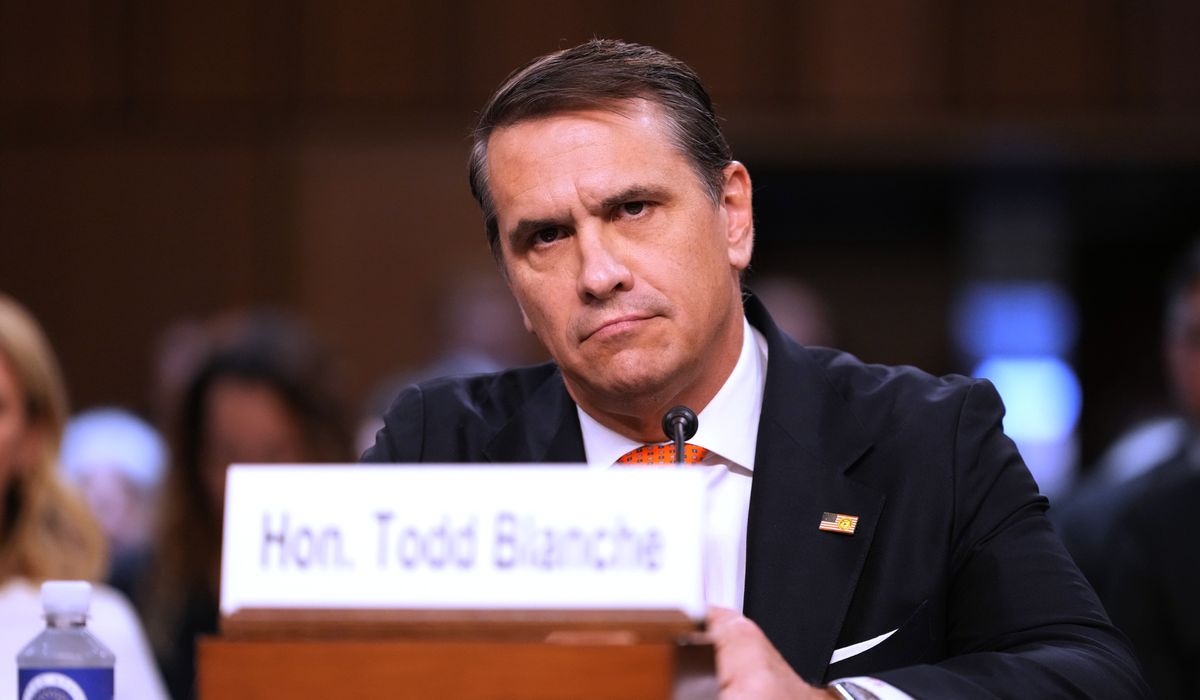
Acting Attorney General Todd Blanche issued a formal order late Sunday terminating President Trump’s $1.8 billion Anti-Weaponization Fund to compensate his political allies, a move that immediately raised questions about the Justice Department’s discretion and the political implications of shutting down a major, politically linked funding mechanism.
The order landed suddenly and carries a clear, concrete result: the $1.8 billion fund designed to compensate political allies will no longer operate under its prior authorization. That dollar figure alone makes this a high-stakes action that touches legal defense resources, political networks, and public perceptions about who the Justice Department serves. The abrupt nature of the termination has sharpened already heated debates about institutional fairness and the proper limits of executive power.
Conservatives and Trump allies see this as another front in a broader struggle over whether federal institutions are being used against a political faction, and they will frame the decision as evidence that the system is tilted. From that viewpoint, killing a dedicated fund for allies looks less like routine policy and more like a targeted move with political consequences. The visceral reaction on the right underscores how deeply distrust of federal prosecutorial discretion has taken hold among Republican voters and lawmakers.
Legal and budgetary questions follow naturally from the order: how will legal fees and settlements previously expected to be covered be handled now, and what accounting steps must the department take to unwind commitments or promises tied to the fund? The size of the fund means the department may face complex accounting and contract issues before the termination is fully implemented. Those practical headaches will be watched closely by lawyers, political aides, and congressional budget hawks alike.
For Republicans who view the Justice Department as having drifted into partisan enforcement, this decision will be presented as proof of inconsistent application of rules. They argue that the appearance of fairness matters as much as the law itself, and any perception that enforcement resources are weaponized undermines confidence in institutions. That argument will drive pressure for oversight and possibly legislative changes to clarify how such funds can and cannot be used in the future.
Democrats and Justice Department defenders, meanwhile, will likely justify the move on procedural or policy grounds, saying the department must remain above partisan entanglements and follow established law and ethics standards. Expect them to emphasize institutional independence and the risk posed by funds that tie federal resources to political outcomes. The tug-of-war over narrative will be as consequential as whatever legal steps follow.
Practical consequences for people who might have relied on that money are immediate: advisers, staffers, or allies counting on reimbursement could now need to find alternative funding or legal defense arrangements. That reality will create pressure points in conservative political circles, exposing networks that assumed federal backstops. It also raises tactical questions for campaign operatives and outside groups about how to protect allies when government policies shift overnight.
Politically, the move ensures this issue will not quiet down; instead it will become a talking point in debates over the role of the Justice Department and presidential prerogatives. Republicans in Congress are likely to press for explanations, watchdogs will scrutinize the legal footing of the order, and rank-and-file voters will interpret the action through the lens of broader grievances about elite institutions. Whatever else happens, the termination transforms a budgetary choice into a political struggle that will play out in hearings, op-eds, and campaign messaging.

