

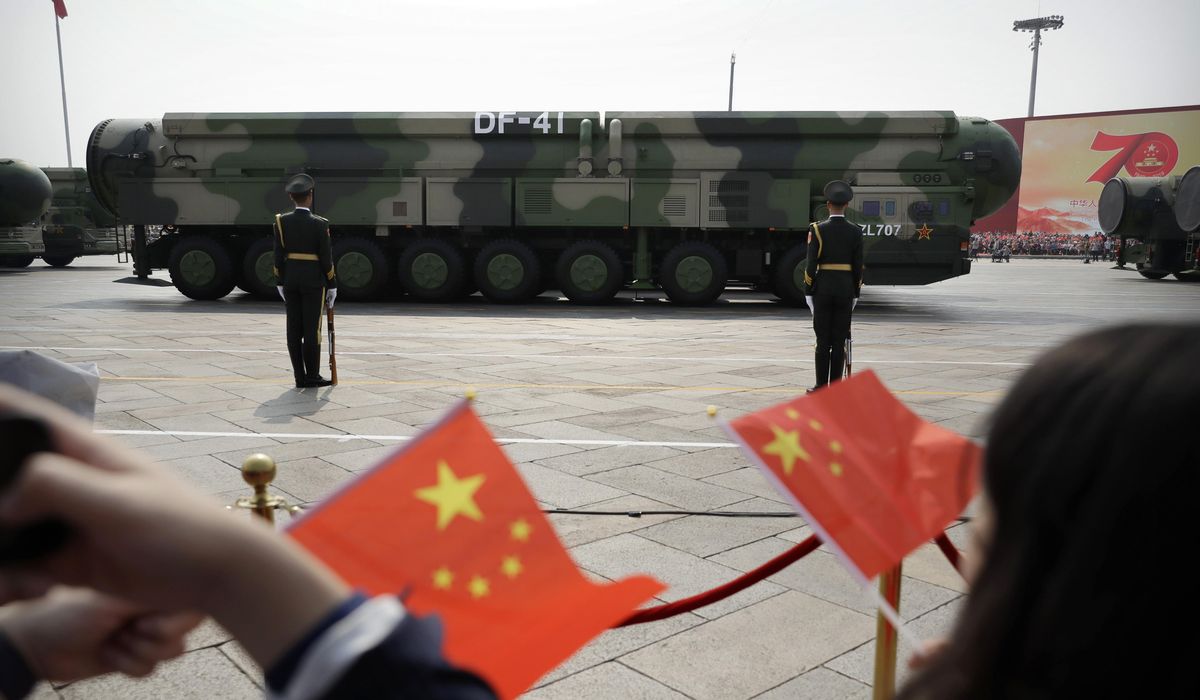
U.S. policymakers face a growing danger as private Chinese firms keep supplying missile and nuclear-related gear to adversaries, a trend that complicates deterrence, arms control and export enforcement in the 21st century.
The new picture from congressional analysts is unsettling but clear. Chinese companies are continuing to sell nuclear weapons and missile-related systems and goods to Russia, North Korea and Iran, according to a Congressional Research Service report. That sentence captures the core finding and forces a hard look at how dual-use trade and corporate networks operate across borders.
This is not an abstract problem limited to satellites and lab talk. These sales help hostile regimes modernize delivery systems and expand the reach of their arsenals, eroding regional stability and raising the risk that technology from civilian supply chains ends up in military programs. When firms move parts and know-how with little oversight, the result is an upgraded threat picture for America and its partners.
Lawmakers on both sides of the aisle should recognize the practical consequences. U.S. friends in Europe, the Middle East and East Asia are already adjusting their defense plans in response to improved missile ranges and accuracy. That means more resources for missile defense, better intelligence sharing, and a tougher posture to deter aggression, all of which will be harder to sustain if proliferators keep arming revisionist states.
Corporate behavior matters here as much as state policy. Some Chinese companies operate in legal gray zones or exploit loopholes in export rules, while others intentionally route components through third countries to disguise their origin. That kind of playbook makes enforcement a cat and mouse game and lets supply chains keep the parts moving even when governments say they want to stop them.
Sanctions and export controls can work when they are smart and consistently applied, but they are not magic. Targeted measures can close channels, freeze assets, and deter banks from handling suspicious transactions, yet bad actors adapt fast. The real leverage comes from combining controls with persistent investigation, corporate accountability and multilateral pressure so that firms find it harder to do business with dangerous programs and states.
There is a technological angle that cannot be ignored. Advances in materials science, small electronics and software have lowered the bar for building more lethal delivery systems. Components that once required a factory now come from common industrial suppliers. That diffusion means export policy must keep pace with innovation, not trail behind it, if we want to prevent civilian tech from fueling military programs abroad.
The report throws light on one more uncomfortable fact: global markets are porous. Even firms that are not overtly state-directed are embedded in ecosystems where military end uses are easy to hide. Tracking ownership, transaction chains and shipping routes is tedious work, but it is necessary to map how components travel from production lines to launchers and warheads.
U.S. strategy should emphasize durable deterrence and longer-term economic pressure without overpromising quick fixes. Strengthening customs screening, tightening export licenses, and improving coordination with allies can reduce the flow, but enforcement must be relentless and adaptive. The goal is to raise the cost for anyone who tries to supply prohibited systems so that the economics of proliferation become unattractive.
Oversight and transparency deserve a spotlight too. Congressional review and public reporting make it harder for companies to operate in the shadows, and they give voters a clearer view of where policy is succeeding or failing. If Congress, regulators and partners push hard enough to close loopholes and expose networks, the market incentives that enable these sales will start to shift.

