

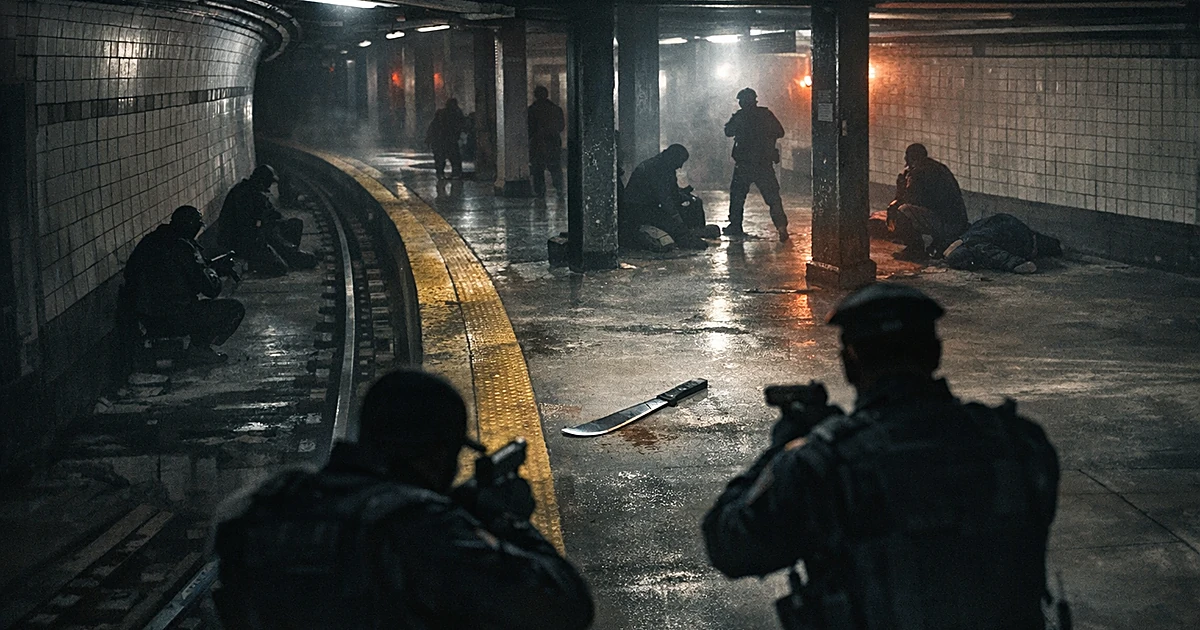
A machete attack at Grand Central left three elderly commuters injured and a suspect dead after officers fired following repeated warnings; the incident reopened questions about subway safety and political leadership.
On Saturday morning a 44-year-old man identified as Anthony Griffin attacked strangers on the 4, 5, 6 platform at Grand Central Terminal with a machete, then was shot by NYPD officers after refusing commands. The assault began around 9:50 a.m. and left three elderly people hospitalized, while the suspect was taken to Bellevue Hospital and pronounced dead.
The three victims were an 84-year-old man, a 70-year-old woman, and a 65-year-old man, all taken to hospitals in stable condition with wounds that included head and face lacerations, an open skull fracture, and a shoulder laceration. Authorities described the strikes as random and said the victims had no apparent connection to the attacker, underscoring how vulnerable everyday riders can be.
Officers confronted Griffin on the busy platform as he behaved erratically and reportedly called himself “Lucifer.” Police say detectives ordered him to drop the machete more than 20 times but he refused, then advanced on them with the blade extended, creating an immediate threat to anyone nearby on one of the city’s busiest transit corridors.
“Officers shot and killed 44-year-old Anthony Griffin after he advanced toward them with a machete, ignoring over 20 warnings to stop.”
The department laid out the same sequence in public remarks: detectives tried to de-escalate, repeatedly commanded compliance, and then used lethal force when the suspect lunged. One detective fired twice, striking Griffin, and medical staff later pronounced him dead at the hospital, closing that part of the scene while questions about causes and prevention remain open.
“Our officers were confronted with an armed individual who had already injured multiple people and was continuing to pose a threat. They gave clear commands. They attempted to de-escalate. And when that threat did not stop, they took decisive action to stop it and to protect New Yorkers on one of the busiest train platforms in the city.”
Those words frame the incident from the NYPD perspective and defend the detectives’ split-second decisions. In a city where police use-of-force is often debated and second-guessed, this event is being presented as a clear case where hesitation could have cost lives, and where officers on scene prevented further harm to commuters.
Gov. Kathy Hochul described the attack as a “senseless act of violence” on social media, a phrase that signals shock but offers no specific plan. The standard language from Albany keeps attention on the tragedy while leaving accountability and preventive steps vague, and many riders want concrete answers instead of condolences.
New Yorkers are left asking why a man could bring a large blade onto a major platform and begin slashing without immediate containment, and why elected officials routinely treat such incidents as simply random. Calling violence random has become a bureaucratic shrug that comforts no one, especially elderly commuters who rely on safe, predictable transit to live their lives.
Key facts remain unknown: authorities have not released any motive, any criminal history for Griffin, the origin of the machete, or whether he had prior contacts with mental health services or law enforcement. With the suspect dead, prosecutors cannot press charges and many of the standard investigative threads are constrained by the immediate outcome.
This episode fits into a troubling pattern of violence in the transit system that has made city travel feel riskier, especially for older riders. While officers acted where it mattered, the broader problem lies with leadership that often talks tough about safety but does not squarely answer how these attacks keep happening under its watch.
The incident sends a clear message about the stakes of public safety policy and political signaling. Detectives did what the public expects by stopping an active threat; now the larger challenge is for officials to explain the failures that let a machete onto a crowded platform and to offer steps that actually reduce the chance of a repeat.

