

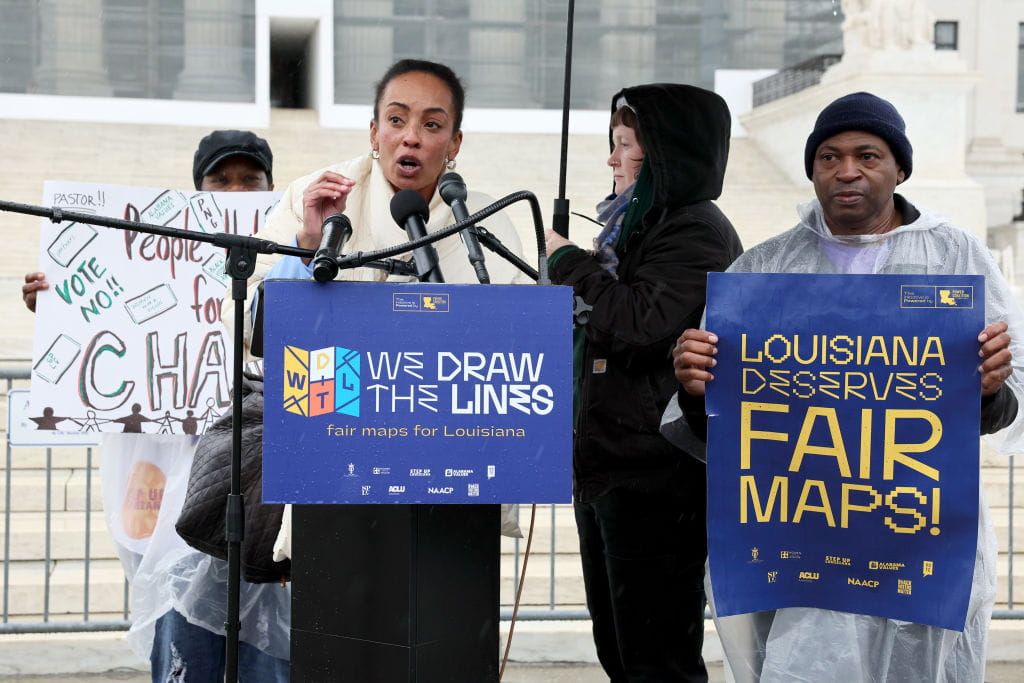
The Supreme Court’s recent move reshapes how courts and legislatures approach redistricting by drawing a sharper line between permissible partisan considerations and impermissible race-based design, setting the stage for a renewed fight over how maps get drawn and who gets to decide them.
The timing of the decision, dated Apr 30, 2026, could not be more consequential for the midterm map fights ahead. Court action like this adds real legal weight to a debate that previously played out mostly in statehouses and political ads. Voters and officials will feel the ripple effects as parties reconsider strategy and litigation plans.
The Court’s language underlines a simple constitutional reality about race and representation. “There’s political gerrymandering, and then there’s racial gerrymandering – and the two are not equally permitted under the Constitution.” That line forces a boundary that states and courts must respect.
That distinction matters because it returns some decisions to elected legislatures instead of leaving every map to be second-guessed by judges. Republicans argue that when courts treat politics like race, they undercut democratic choice and reward litigation over the ballot box. The ruling pushes back against that trend and reinforces state authority over political questions.
At the same time, the decision reminds mapmakers that race as a primary factor triggers stricter scrutiny. Lawmakers who rely on racial classifications to shape districts will now face clearer constitutional limits. This should reduce the use of race as a blunt instrument in the name of compliance or advantage.
From a practical standpoint, the ruling simplifies enforcement for some courts but complicates the task for litigants. Plaintiffs must now demonstrate racial predominance with sharper proof, while defendants can point to legitimate political goals. That recalibration will change the kinds of evidence and expert testimony that matter in future cases.
Politically, the Court’s posture favors clarity over endless churn. When courts draw crisp legal lines, legislators can plan within known constraints instead of reacting to shifting standards. Republican leaders will see this as an opportunity to pursue coherent, statewide maps that reflect party strength rather than race-based engineering.
The decision also affects how reform advocates frame their arguments. Civil-rights groups that equate partisan outcomes with racial harm will need new legal strategies after this ruling. Expect a shift toward targeted litigation that tries to prove racial motives more directly, rather than relying on political correlations alone.
States with independent commissions or tightly drawn rules now have a stronger incentive to stick to neutral criteria that prioritize compactness, communities of interest, and respect for political subdivisions. Those neutral principles will gain more legal traction when courts are less willing to blur race and politics. Legislatures that follow transparent processes will be harder targets for successful lawsuits.
There is also a practical message for plaintiffs and defense teams: the evidentiary bar has moved. Experts who once used broad demographic correlations to make their case must now show how race, not politics, drove specific map choices. That narrows the field of viable claims and raises the cost of chasing litigation instead of elections.
What this ruling does not do is eliminate controversy. The underlying incentives to shape maps for advantage remain, and politicians will continue to fight for every seat. But by separating race from politics more clearly, the Court forces a more honest debate about who wins and why, and it shifts part of that fight back to voters and state legislatures.
Ultimately, the decision reshapes the battlefield without ending the war. It privileges constitutional limits and state decision-making while tightening the rules on race-based districting. For Republicans and others who favor electoral clarity and legislative accountability, that is a welcome reset in how America resolves its most contentious redistricting disputes.

