

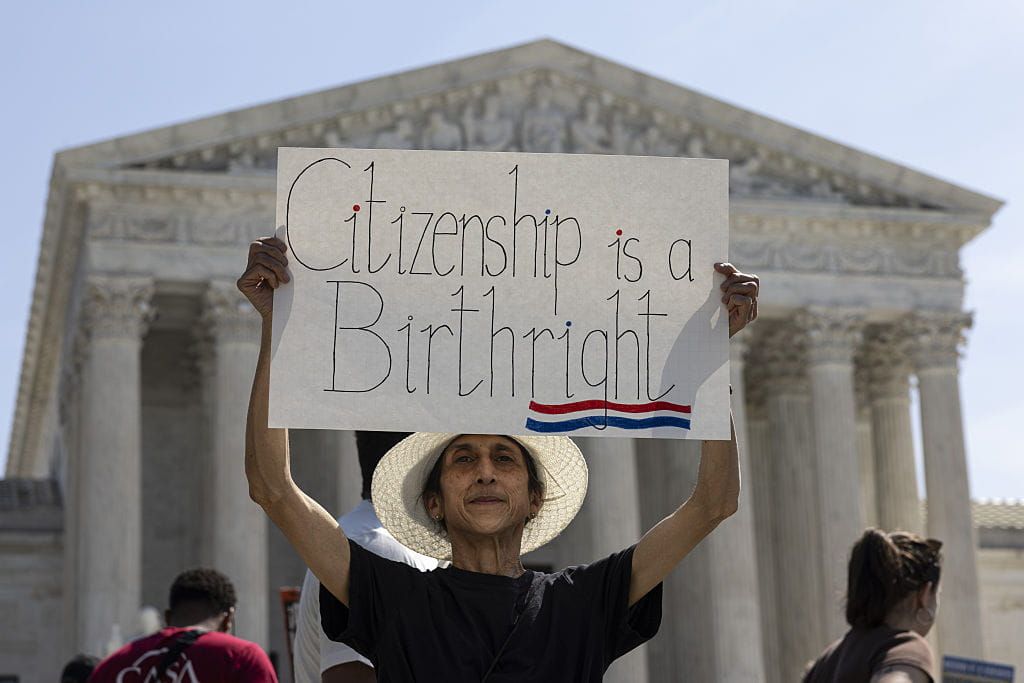
On June 30 the Supreme Court rejected President Trump’s executive order aimed at ending birthright citizenship, issuing a tight 5-4 decision that leaves the Fourteenth Amendment intact while sharpening the political and legal fight over how to limit automatic citizenship for children born here to parents unlawfully or temporarily present.
The Court’s ruling in Trump v. Barbara overturned the White House move that had been drafted to end automatic citizenship for babies born in the United States to parents here unlawfully or temporarily. Federal judges had already blocked enforcement after the order was signed in January 2025 and scheduled to take effect 30 days later, so the decision simply resolved a high-stakes legal headache rather than immediately changing policy on the ground. Republicans now face a choice about whether to press a legislative path or regroup politically.
Chief Justice John Roberts wrote the majority opinion, stating that “children born of parents unlawfully or temporarily present in the United States … satisfy both elements of the Citizenship Clause.” He concluded that, “under the Constitution,” “they are citizens at birth,” reaffirming the plain reading of the Fourteenth Amendment as ratified in 1868. Roberts’s opinion rests on the Amendment’s twin requirements: birth in the United States and subjection to its jurisdiction, which the majority found fulfilled.
The split was narrow: five justices sided with the majority while four dissented, exposing the Court’s fragile balance on hot-button immigration issues. Justice Brett Kavanaugh agreed with the outcome but not the majority’s reasoning, creating an unusual three-way ideological dynamic on the bench. That fracture matters because it opens different legal avenues for future cases and gives Congress a potential role if lawmakers choose to act.
Justice Samuel Alito framed his dissent bluntly, calling the ruling “one of the most important decisions in the history of the Court” – and “a serious mistake.” Justice Clarence Thomas produced a lengthy, 91-page dissent, arguing the majority’s account was “not historically accurate,” and asserting it “adds to the sad history of the Fourteenth Amendment, which was designed and understood to secure equal rights for the freed blacks.” Those words capture the core conservative critique that historical meaning and textual purpose were mishandled.
Justice Kavanaugh’s separate note highlighted a legislative option and a narrow statutory argument, stressing that while he concurred in the judgment he disagreed with the majority’s constitutional framing. He observed that Congress “could amend” federal law “or otherwise enact new legislation establishing exceptions to birthright citizenship for children born to foreign citizens unlawfully or temporarily in the country.” That line gives Republicans a clear, if difficult, route: build a statutory fix rather than rely on executive action.
Politically, the decision hands conservatives a painful short-term loss but a plausible long-term opening. Executive orders can be attractive for immediate results, but the Court’s rebuke reasserts constitutional limits and highlights the need for durable legislative solutions if Republicans want change. Passing a new federal statute would require compromise and votes in both chambers, which is a steep hill in today’s divided Washington.
Lawyers and lawmakers will now parse the majority’s reasoning for vulnerabilities and carve out new strategies to achieve similar ends by other means. Litigation is likely to continue as advocates test statutory mechanisms, and Congress could pursue narrowly tailored exceptions or procedural changes tied to immigration enforcement. Any congressional push will be contested vigorously in committee and on the floor, and success is far from assured.
The ruling also reframes campaign messaging. Republicans can argue the decision emphasizes why Congress must act and why voters should demand real policy changes rather than temporary executive fixes. Democrats can point to the Court’s preservation of the Fourteenth Amendment as a defensive victory and a shield against abrupt reversals of settled expectations for anyone born here.
For now, the legal status quo stands: the Fourteenth Amendment’s birthright language remains in force and those children are recognized as citizens at birth. The practical takeaway for Republicans is tactical: if the policy goal is to limit automatic citizenship, the path runs through Congress and careful statutory drafting rather than unilateral executive orders. That reality will shape the next round of politics and the legal strategies that follow.

