

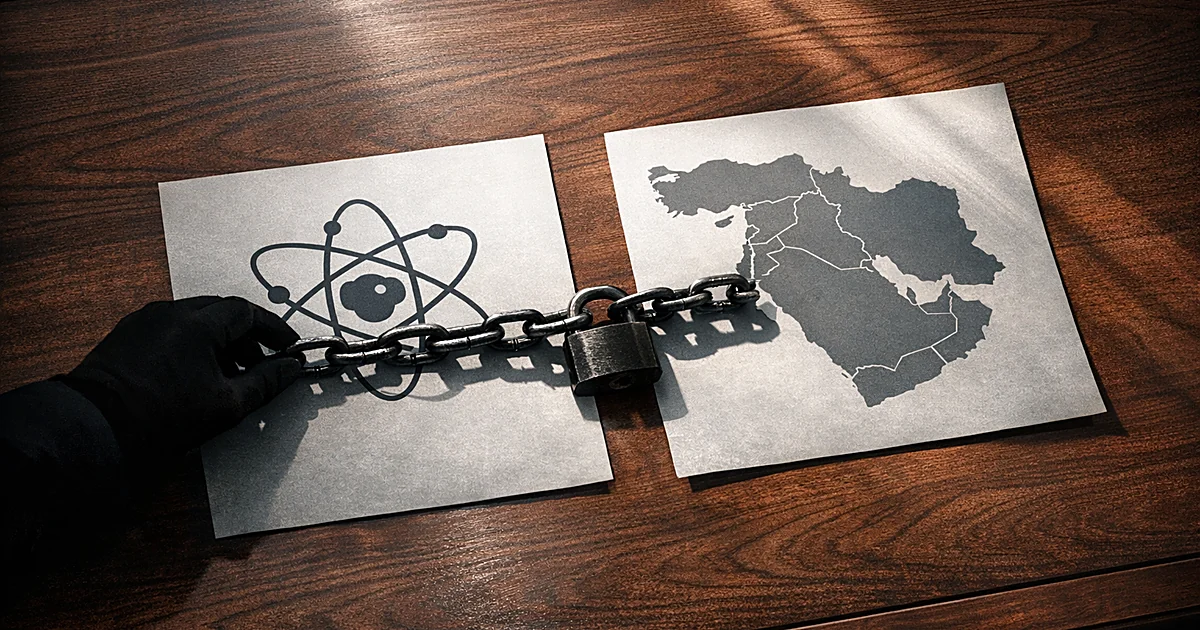
President Trump declared the freshly signed U.S.-Saudi civilian nuclear pact “totally subject” to Riyadh joining the Abraham Accords, setting off a scramble over whether the condition was part of the deal or tacked on after the signature.
The agreement, inked by Energy Secretary Chris Wright and Saudi Energy Minister Prince Abdulaziz bin Salman, is a classic “123 Agreement” that lays the legal groundwork for U.S. companies to help Saudi Arabia build civilian nuclear power. On paper it ties two governments into a bilateral safeguards arrangement and a two-year study to determine whether uranium enrichment is needed for the Saudi program. That study is exactly the clause that worried nonproliferation hawks and triggered the public back-and-forth. The White House later framed the deal with a hard political condition aimed at achieving a regional diplomatic payoff.
Trump’s social media post said “there will be no enrichment of material” and described the pact as “totally subject” to Saudi normalization with Israel, an announcement that caught allies and some of his own advisers off guard. White House Press Secretary Karoline Leavitt reinforced the line by telling reporters that if the Saudis don’t join the Abraham Accords, “the deal is off.” When asked why the condition wasn’t mentioned at the signing, she said Trump “is always the final dealmaker.” Those three short phrases changed the optics of the agreement overnight.
The absence of the so-called “gold standard” non-enrichment pledge in the original text raised alarm bells because Saudi negotiators refused that language. Trump’s follow-up, saying the U.S. is “not opposed to Civil (Non-Enriched) Nuclear Facilities,” attempts to draw a legal boundary against enrichment while leaving political leverage in play. Andrea Stricker warned bluntly of the long-term danger if that boundary proves fragile:
“Yet this puts Washington and future presidents in the position of having to bomb their own enrichment plant if the Saudis decide to pursue nuclear weapons, whether using this technology or by working on them on their own.”
Republican allies and critics alike have reacted on practical grounds rather than ideology. Sen. Tim Kaine raised a benchmark by pointing to the UAE deal and the importance of the International Atomic Energy Agency’s additional protocol, saying that the UAE’s commitments showed how to keep a civilian program peaceful. Kaine put the risk plainly: “We did a civilian nuclear deal with the UAE, and they agreed to follow the additional protocol, which is very important to make sure if it’s a peaceful program that there’s no cheating, and it stays a peaceful program. So, the fact that the Saudis have apparently not agreed to that, I mean, it just kind of raises a red flag.”
Other Republicans took a more confident stance on protections. Rep. Don Bacon said he thinks the deal “contains the right protections” and stressed that many countries operate civilian nuclear energy safely with proper oversight. Marco Rubio framed the broader choice bluntly, arguing that if Washington doesn’t win these contracts, competitors will, and that carries strategic consequences: “We’re not the only show in town, but we’re the best show in town. We want to make sure that it’s our companies they’re picking.”
Analysts are split on whether the Abraham Accords condition was a planned bargaining chip or an improvised political add-on. Bryan Clark suggested the president was responding to pressure from pro-Israel advocates and national security hawks, calling it “the president trying to kind of backtrack and address the concerns from a lot of Israel supporters and hawks in general that we didn’t get anything in return for this.” Clark argued that if the pledge had been negotiated up front, the White House would have touted it during the signing.
Robert Einhorn of Brookings offered a skeptical, dealmaker’s read: “He probably knows that he’s not going to get Saudi normalization or willingness to normalize, but he may think that if he now drops that new condition, he could get something for it, perhaps something having to do with enrichment or verification or something like that.” Einhorn added that the announcement surprised not only the Saudis but “all of his principal advisers in the administration by surprise,” and he warned, “I wouldn’t be confident that these new conditions will persist for very long.”
Congress has a 90-day review window to flag concerns, though lawmakers cannot block the agreement outright, a reality Rep. Brad Sherman described as Congress being “behind the eight ball and can’t do anything.” That constrained review makes the political leverage Trump announced more consequential, since diplomacy or political pressure may be the main tools left. The Saudis must weigh whether American nuclear technology is worth the political cost of a step toward Israel that Riyadh has long tied to Palestinian concessions.
The strategic context matters: a Republican administration’s priority is to secure U.S. commercial and security interests while denying rivals influence in the Gulf. That competitive logic, and the doctrine of using deals as leverage, is why supporters argue the president’s move could produce bargaining space. Yet the nonproliferation community remains concerned that a two-year enrichment study and a conditional promise leave too much room for a future problem.
Voices across the beltway know the stakes: “You never know whether Trump’s serious about anything,” Rep. Sherman sniffed, capturing the uncertainty that now hangs over a signed pact and a public presidential condition. Andrea Stricker saw a silver lining, saying Trump’s comments “may, helpfully, serve to delay the agreement from coming to fruition, since it was already signed and the Saudis now have to address whether they want to normalize relations with Israel.” Delay, in this case, may be a deliberate tactic as negotiators sort out whether the political price fits the strategic gain.

