

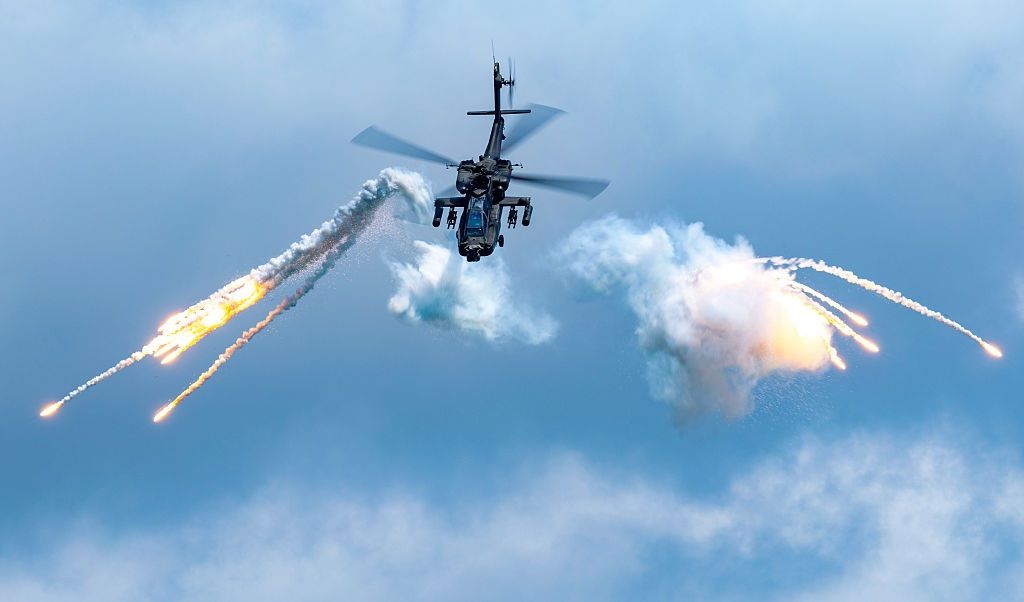
Tensions rose sharply in the Strait of Hormuz after an Apache AH-64 crashed during a patrol off Oman, two crew were rescued, and Washington responded with strikes ordered by the president.
US Central Command reported that an Apache AH-64 attack helicopter crashed while on patrol near the Strait of Hormuz and that both crew members were recovered and stable. The early accounts left the cause unclear, with one major outlet saying, “It was not immediately clear whether the Apache was shot down by Iranian fire, experienced mechanical failure, or encountered some other problem.”
Subsequent reporting introduced a different detail: “Two US officials said the helicopter was brought down by an Iranian drone. A separate source familiar with the incident said it was perhaps an Iranian Shahed drone that struck the US helicopter.” That mix of possibilities — mechanical fault, accidental collision, or hostile action — complicates immediate assessments.
Central Command noted the crew were picked up “within approximately two hours and are in stable condition,” and highlighted a novel element to the rescue. As CNN explained, “The successful rescue of the two uninjured crew members — accomplished in part by a US Navy unmanned surface vessel (USV) from Task Force 59 in a historic first for aircrew water recovery — demonstrates the innovation and readiness of our forces under this administration.”
With that information in hand, the president moved quickly and publicly. He declared the need for retaliation and ordered strikes in response to what he, and military leaders, characterized as aggression. The administration framed the action as self-defense, aimed at degrading Iranian military capabilities tied to the incident.
“I have just been informed by our Great Military that last night [June 8] the Iranians shot down one of our highly sophisticated Apache Helicopters while patrolling over the Strait of Hormuz. There were two pilots involved, both are safe and uninjured. Nevertheless, the United States must, of necessity, respond to this attack. Thank you for your attention to this matter! President DONALD J. TRUMP”
U.S. Central Command later explained, “U.S. Central Command (CENTCOM) forces began launching self-defense strikes against Iran at 5 p.m. ET today at the Commander in Chief’s direction, in response to yesterday’s downing of a U.S. Army Apache helicopter. The mission is a proportional response to unjustified Iranian aggression.” That wording signals measured intent, but the underlying message is forceful.
Those who study military deterrence will note the stakes: the Strait of Hormuz is a choke point for global commerce, and persistent Iranian aggression must be met with credible pushback. For Republican strategists, this incident validates the “Peace Through Strength” approach — clear, decisive responses backed by the capability to follow through.
Some analysts will argue for restraint to avoid escalation, while others insist on degrading the specific capabilities that enable attacks on shipping, allies, and US forces. The practical options on the table include strikes on drone production, air defense systems that support Iranian missile and UAV employment, and facilities used to plan and launch operations in the Gulf.
Beyond kinetic responses, the diplomatic and economic dimensions matter: pressure must uphold navigation rights and ensure allies in the Gulf can operate without fear. The message from a Republican perspective is straightforward — allowing Iran to test limits with ambiguous aggression invites more attacks, so deterrence must be unmistakable and sustained.
As the smoke clears, facts will continue to emerge about how the helicopter went down and whether Iranian action was deliberate or reckless. For now, the United States has signaled it will not tolerate threats to its forces or to free passage in the Hormuz corridor, and that resolve will shape Tehran’s calculations moving forward.

