

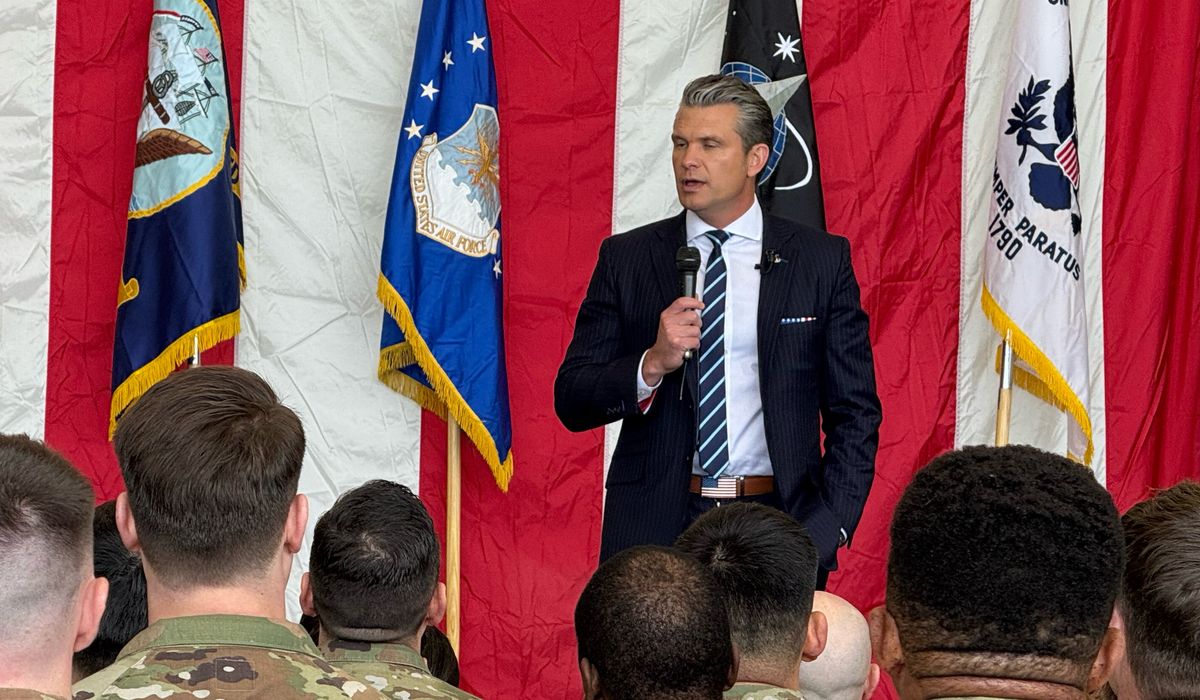
Defense Secretary Pete Hegseth is set to meet his Chinese counterpart, Defense Minister Adm. Dong Jun, on the sidelines of an Association of Southeast Asian Nations session in Malaysia, a high-stakes moment aimed at preventing misunderstandings while keeping American interests front and center. The visit is about managing competition, reassuring allies, and making sure military-to-military contact reduces risk without rewarding aggressive behavior.
Pete Hegseth’s trip to Malaysia brings U.S. defense leadership into direct conversation with China at a regional forum that matters. Meeting Adm. Dong Jun in person gives both sides a chance to test whether communications can be candid without conceding ground on principles like freedom of navigation and sovereign rights. For Republicans, that kind of engagement should always be backed by strength and clear red lines, not vague diplomacy that leaves allies guessing.
The Association of Southeast Asian Nations setting is significant because it gathers the countries most affected by Beijing’s moves in the South China Sea and beyond. Hegseth’s presence signals the United States remains engaged in the region and committed to a rules-based order. That sends a simple message: America stands with partners and expects behavior consistent with international law.
Direct talks between defense chiefs are useful for lowering the chance of accidental clashes at sea or in the air, and they provide a forum to raise blatant concerns. Still, these conversations should not obscure underlying strategic competition or be used by Beijing to legitimize coercion. Republicans will argue the U.S. approach must mix diplomacy with a robust deterrent posture and clear military readiness.
On the table will likely be issues that matter to U.S. forces and regional partners alike: freedom of navigation, transparency around naval operations, and channels for crisis communication. Hegseth can push for protocols to prevent dangerous encounters while insisting on accountability for actions that destabilize the region. Operational clarity between militaries is a practical step; it must not become a substitute for confronting bad behavior.
The meeting also matters politically back home because voters expect the Pentagon to protect American interests without apologizing for American strength. For Republicans, the priority is clear: stand firm, reassure friends, and call out coercion. That principle should guide any exchange with Adm. Dong Jun, ensuring the encounter strengthens deterrence rather than diminishing it.
ASEAN’s forum offers cover for bilateral discussions, but the substance of those talks will be scrutinized by capitals across Asia. Allies in Tokyo, Canberra, and Seoul will watch closely for signals about U.S. commitments and capability alignment. Hegseth can use this moment to reinforce joint readiness and interoperability that make clear the United States will act if regional stability is threatened.
China will likely frame any conversation as proof of its own legitimacy on the world stage, so the United States must avoid granting political victories through friendly optics alone. The American posture should combine frankness with firm follow-through: clear demands paired with visible capability. That approach keeps diplomacy honest and deterrence credible.
Military-to-military channels are important, but they must be built on reciprocity and good-faith behavior, not on a presumption of equal respect for norms. Hegseth can insist on data sharing for safety and de-escalation measures while making it clear that coercive campaigns will meet pushback. Those are the kinds of practical outcomes that matter to sailors, aviators, and allied leaders who live with the consequences of miscalculation.
Ultimately, Hegseth’s meeting with Adm. Dong Jun in Malaysia will be judged by what follows rather than the cordiality of a photo op. Concrete steps that reduce the risk of conflict, reinforce alliances, and uphold international rules are the yardstick Republicans will use to measure success. Engagement is welcome when it strengthens deterrence and protects American interests, and that should be the guiding logic of this visit to the Association of Southeast Asian Nations.

