

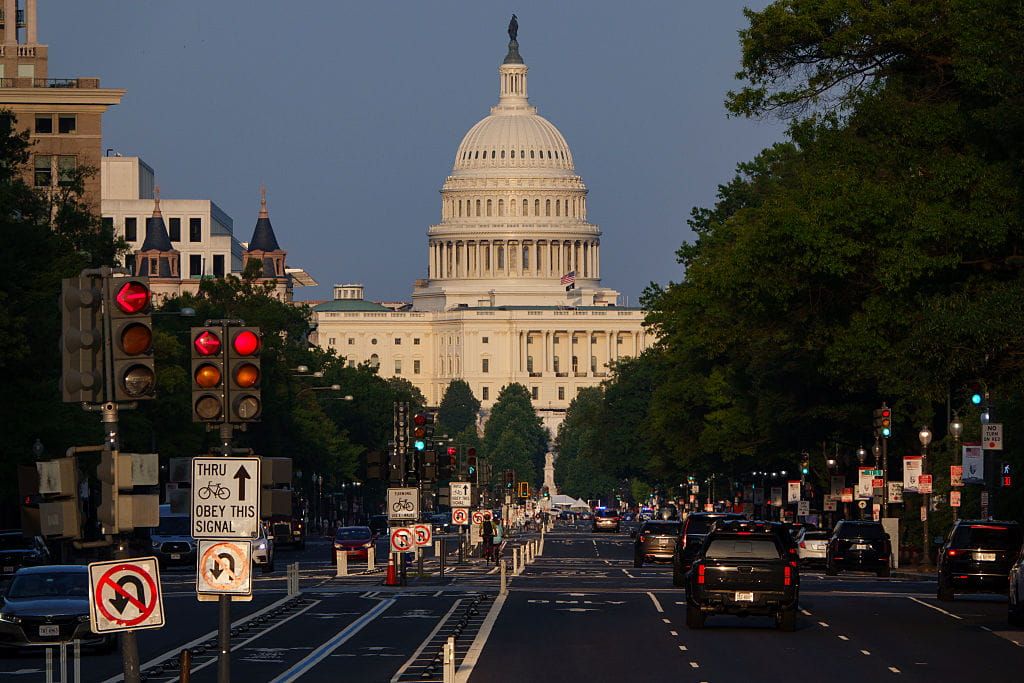
Lawmakers traded votes and theater this week as the House pushed war powers and budget measures that face long odds in the Senate, leaving Congress nowhere near the two-thirds margins needed to overcome a presidential veto and running the clock down on funding before September 30.
Lawmakers wrapped a short session with a mix of symbolic moves and narrow wins, but little that changes the immediate trajectory for federal policy or funding. Don’t be silly; this is the 119th “do nothing” Congress. Before leaving for an extended weekend the House approved another war powers resolution aimed at halting military action against Iran, while the Senate rejected its version.
On July 23 the House approved the war powers measure 214 to 208, with Republican Reps. Tom Barrett of Michigan, Warren Davidson of Ohio, Brian K. Fitzpatrick of Pennsylvania, and Thomas Massie of Kentucky joining all House Democrats. The text and tone of the resolution are described as a largely symbolic rebuke of President Donald Trump’s campaign against Iran, so its practical effects depend on what happens in the upper chamber and with the White House.
The lower chamber also cleared a separate spending package on Wednesday, voting 216 to 214 for a $95 billion framework that covers military accounts, agriculture, and grants tied to state-level SAVE Act measures. The vote tracked party lines for the most part, with most Republicans backing the plan and most Democrats opposing it; Frederica Wilson was recorded as not voting while recovering from an eye procedure in South Florida. That $95 billion figure establishes a baseline for fiscal year 2027 work but does not by itself guarantee final appropriations.
The House was active otherwise, sending roughly 31 bills and resolutions through the floor this week, but activity is not the same as impact. Many of those measures face skeptical prospects in the Senate, and procedural differences between the chambers mean that passage in one does not assure enactment. The practical test for any House initiative remains whether the Senate will take it up and whether a president will accept it.
The Senate, by contrast, advanced only a handful of measures this week and decisively blocked a war powers resolution of its own, voting 47 to 49 against it. Democrat John Fetterman was the only Democrat to join Republicans in voting no, while Susan Collins cast a vote in favor. Senators Rand Paul and Lisa Murkowski were absent despite prior statements that signaled reservations about escalation, and their absence helped tip the outcome.
Senate Republican leadership signaled a cautious posture toward the House budget framework, with Majority Leader John Thune (R-SD) saying, “It’s a possibility that if necessary we could pull that budget resolution passed by the House and use it to fund government. I hope that’s not necessary.” He added, “We’ve had conversations, productive conversations on both sides of the aisle, on a funding resolution that would carry us past the November election.” That hedged language underlines the Senate’s readiness to hold cards for later leverage rather than immediately locking in the House plan.
Absences and a few cross-party votes determined the Senate margin. Had Rand Paul and Lisa Murkowski been present and voted as they have in prior moments, the tally might have tied at 49-49. If other absentees such as Katie Britt had been present and if Fetterman had aligned differently, the outcome could have shifted incrementally. But with leaders and holdouts absent for various reasons, the chamber let the resolution fail.
Even if either chamber mustered a majority, the underlying constitutional reality limits Congress’ bite: the president must sign legislation for it to become law, or Congress must override a veto with two-thirds majorities in both chambers. Current vote totals—214 to 208 in the House and a 47 to 49 defeat in the Senate—are far short of the thresholds needed to override a veto, so a presidential rejection would be decisive.
Beyond war powers theater, the calendar matters. Congress faces a hard deadline: funding runs out on September 30, and the Senate’s unwillingness to immediately convert House work into enacted appropriations raises the real prospect of a government funding lapse. If neither chamber produces agreed appropriations or a stopgap continuing resolution, the likely result is federal disruption that inconveniences workers and raises costs.
For now, the House plan will likely reach the Senate next week, where prospects look dim given recent votes and absences. Meanwhile, the mix of narrow margins, procedural choices, and a president empowered to veto legislation keeps the immediate future uncertain and the practical effect of these sessions limited. Bupkis.

