

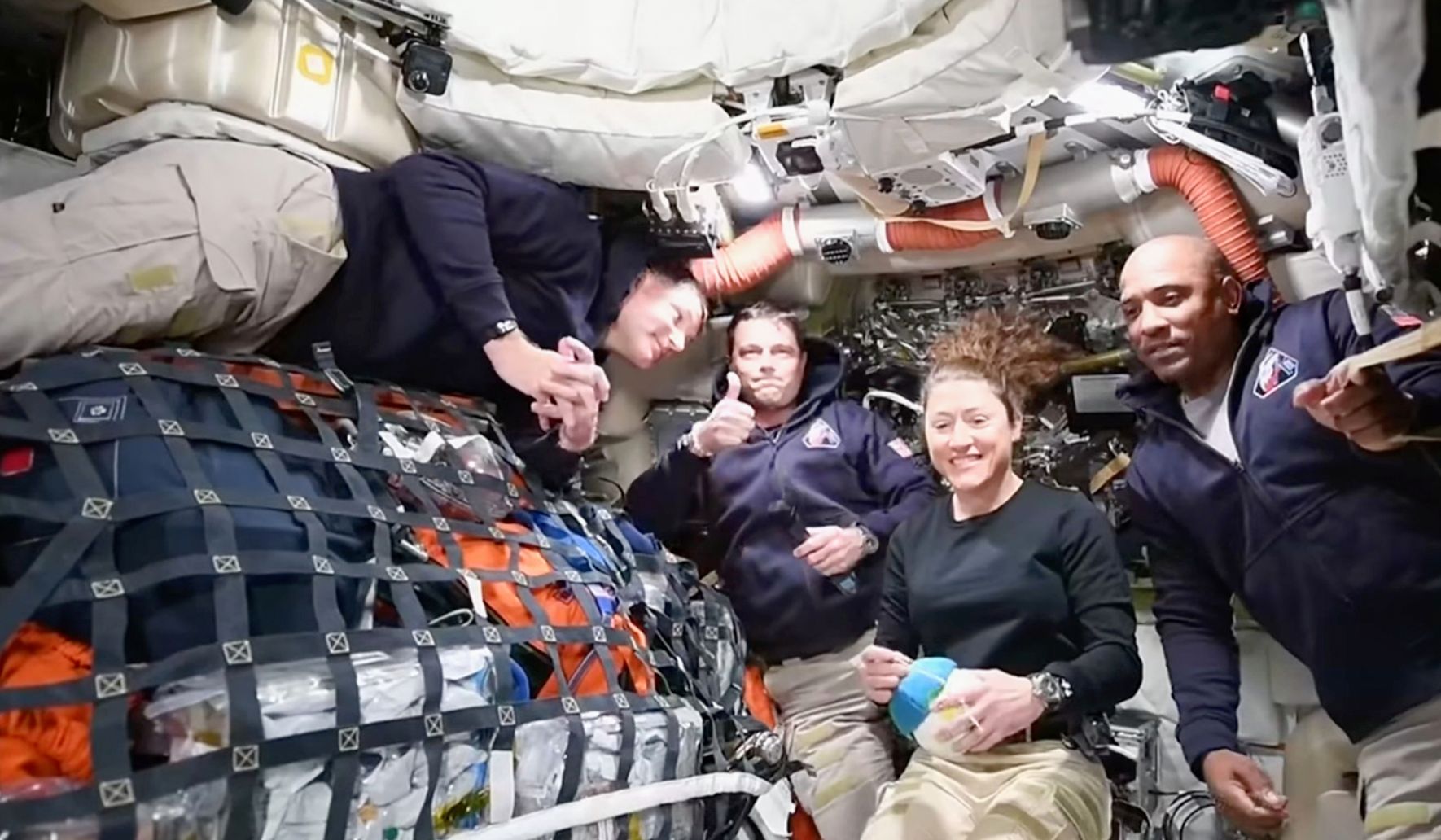
NASA’s Artemis II crew ignited their engines and pushed away from Earth on Thursday night, marking a major push back into deep space and the next step in returning humans beyond low Earth orbit.
The spacecraft’s engines fired on schedule and the vehicle accelerated along a trajectory that carries it away from the familiar low orbits where most human spaceflight has stayed in recent decades. For the crew and the ground teams, that burn meant leaving routines and moving into a different class of mission readiness. The moment underscored how the space program is shifting from short hops and stations to missions aimed at the moon and beyond.
This flight serves as a systems check under real conditions, putting life support, navigation, and communications through sustained use far from home. The crew will evaluate how the spacecraft performs when it can no longer depend on the near-instant support available in low orbit. Engineers on the ground will be watching telemetry and crew feedback to validate designs and procedures that will be used on future lunar operations.
The hardware at the center of this effort combines a heavy-lift rocket stage with a crew capsule built for deep-space endurance. Those elements have been refined after years of testing, and this mission tests both propulsion and the human systems that must operate for days away from Earth. The aim is to prove the whole package can keep astronauts safe, mobile, and connected while they move through a harsher environment.
Historically, humans left low Earth orbit during the Apollo era and then spent decades limited to near-Earth missions and space stations. This flight is intended to close that gap and restore a sustained capability to operate at lunar distances. That matters because operating farther out exposes teams to different hazards and logistical challenges that demand tested solutions.
The mission also provides a platform to exercise navigation techniques for entry and return trajectories and to perfect the handoffs between onboard systems and mission control. Those procedures will become increasingly critical as missions grow more complex and include rendezvous, cargo transfers, and eventual surface operations. Each successful maneuver reduces risk for subsequent missions that will carry larger crews and heavier payloads.
Crew routines will include experiments, system checks, and continuous monitoring of both vehicle health and human performance. The data collected in real time will inform future design tweaks and training programs for long-duration exploration. Even small anomalies can teach teams how to tighten processes and upgrade hardware before committing to surface landings.
On the public side, missions like this rekindle interest in exploration by giving people a story to follow: ascent, coast, system checks, and a planned return. Visuals and mission updates help the public track progress, though much of the work happens quietly in control centers and labs. The broader value comes from proving new capabilities and showing that a pathway back to the moon and onward is technically achievable.
Looking ahead, this sortie feeds into a sequence of missions designed to expand presence and persistence around the moon. Each step builds technical confidence and operational muscle memory for crews and teams alike. Success here lays the groundwork for the more complex tasks that will follow as human spaceflight pushes farther into the solar system.

