

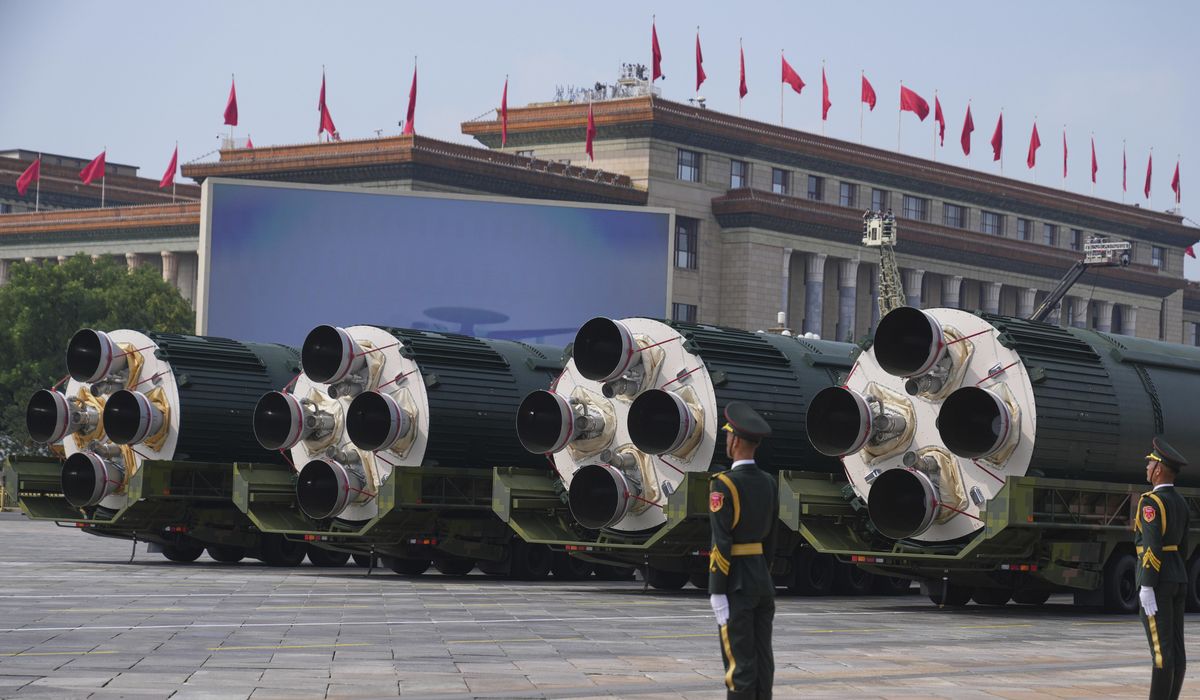
The People’s Liberation Army Rocket Force keeps a growing inventory of nuclear warheads in mountain facilities across central China, and these sites face risks from modern, precise strike capabilities.
The Rocket Force’s expansion reflects Beijing’s push to field more missiles and warheads, with storage moved into hardened mountain complexes that were meant to be safe and secure. Those facilities are often deep inside central China’s terrain, but geography and concentrated stockpiles create predictable targets. As missile accuracy and surveillance improve, those mountain bunkers are not as invulnerable as planners once assumed.
What gets stored in those sites matters: warheads, maintenance equipment, and the specialized tools for arming missiles are centralized to support rapid deployment. Centralized logistics make routine upkeep faster, but they also create single points of failure that an adversary could exploit. The tradeoff between efficiency and survivability is a strategic choice with real consequences for deterrence credibility.
The construction of mountain storage and tunnel systems has long been part of China’s effort to protect strategic assets from conventional attack. Tunnels and rock-cut shelters offer blast protection and concealment, yet they are not immune to modern reconnaissance. High-resolution satellites, signals intelligence, and persistent airborne surveillance have narrowed safe spaces for fixed facilities.
Precision strike weapons have shifted the risk calculus: modern conventional munitions can be guided to specific coordinates with great accuracy, increasing the chance of damaging even hardened structures. Penetrator warheads and stand-off munitions allow an adversary to pose a real threat to underground sites without resorting to nuclear use. That technological trend forces planners to reconsider how many assets should be clustered in one place.
Mobility and dispersal are common responses to that vulnerability, and in recent years there has been a push toward road- and rail-mobile missile units that can relocate quickly. Mobile launchers complicate targeting and reduce the chance that a single strike could cripple a country’s nuclear forces. However, mobile units require reliable logistics, secure communications, and trained crews to maintain readiness when they move frequently.
Missile inventory growth itself raises dilemmas: an expanding stockpile increases deterrence power on paper, but it also demands more secure storage and transport capacity. Larger inventories produce more maintenance requirements and more opportunities for accidents or theft if safeguards are not tightened. That dynamic means quality of storage and command and control is as important as quantity of warheads.
Command, control, and communications are central to survivability. Hardened facilities often include redundant command nodes and protected communications lines to keep orders flowing under attack. Still, networks are vulnerable to cyber operations and electronic warfare that can isolate units or disrupt launch authorization procedures, which creates risks for both stability and safety.
Geography gives both advantage and vulnerability: central China provides depth and cover, but many mountain complexes are reachable from regional launch points and can be observed from space. Concentrating assets in a specific province or range makes those holdings more detectable over time, especially as investment in signals and imagery intelligence continues. Dispersion across regions reduces this patterning but increases logistical complexity.
There are also diplomatic and strategic implications when a state visibly centralizes its arsenal. Competitors and neighbors watch not just numbers but posture and infrastructure, adjusting their own military planning in response. Visible mountain sites can drive arms racing dynamics, as others invest in counterforce capabilities or expand their own deterrents to compensate.
Operational safety inside mountain facilities is another concern: handling nuclear components in confined, remote environments requires strict protocols and trained personnel. Any lapse in maintenance or security raises the chance of an accident or an insider threat, which would be costly even without an external strike. Continuous oversight and robust safeguards are essential where warheads and support gear are colocated.
Modern satellite imagery and open-source analysis have made it easier for outside observers to track changes at storage complexes over time, from new construction to increased vehicle traffic. That visibility influences strategic behavior because it makes concealment harder and increases pressure to adopt survivable practices. Transparency or signaling moves may follow as states balance secrecy with the need to reassure domestic and allied audiences.
The basic lesson is straightforward: hardened mountain storage improves protection relative to exposed sites, but it is not a perfect shield against modern surveillance and precision strike systems. Survivability depends on a mix of dispersal, mobility, redundancy, secure command links, and strict safety procedures. As the Rocket Force modernizes, those operational choices will shape both risk and deterrent value for years to come.

