

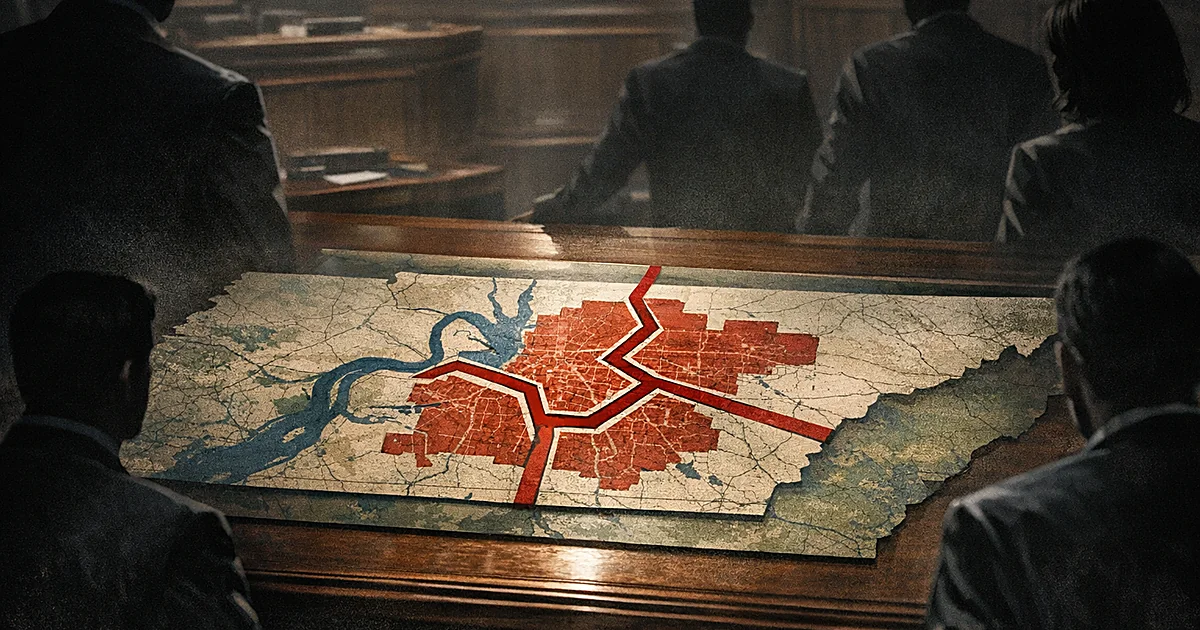
Tennessee Republicans moved quickly to redraw congressional lines, splitting Memphis across three districts, erasing the lone Democratic-held seat in the state’s nine-member delegation, and prompting heated protests and legal challenges as Gov. Bill Lee signed the plan into law the same day.
The Republican-controlled state House passed a new congressional map that fractures Shelby County and dilutes the concentration of Black voters in the area around Memphis. The measure splits Memphis across three districts and effectively removes the majority-Black 9th Congressional District that has long elected a Democrat. Gov. Bill Lee signed the plan into law on the same day the legislature approved it, capping a fast, partisan drive.
The vote provoked loud confrontations on the House floor, with Democratic members yelling after the map cleared the chamber and state troopers called in to restore order. Democratic state Rep. Justin Pearson engaged in a heated exchange with troopers that included profanity-laced outbursts caught on video and shared widely online. The visuals turned the clash into a viral moment that underscored how raw the fight had become.
The new configuration reduces the share of Black voters concentrated in a single district and redistributes them across three neighboring districts. Under the plan, 31 percent of Black voters would be placed in one of those districts, a sharp change from the majority-Black 9th District that had long been the city’s anchor in Congress. Analysts and local leaders warned that the map could flip what had been an 8-1 Republican delegation into a potential 9-0 sweep.
Video from the chamber showed Pearson shouting at officers; one widely circulated clip quoted him saying, “the f*** is wrong with you? You stupid motherf*****.” The footage ignited fierce reaction on social media and in local coverage, and it refocused attention on the theater of the vote rather than only on the lines on a map. Pearson’s flare-ups are familiar to lawmakers and the public from past confrontations.
Pearson was expelled from the Tennessee House in 2023 after breaking decorum rules during a protest about gun violence, only to be reinstated later. That episode remains part of his public record and shaped how both colleagues and opponents read his actions this week. The expulsion and return made him a polarizing figure during the floor fight over redistricting.
Some Democratic lawmakers staged walkouts, and others were reportedly removed by officers as the session escalated, though those accounts are primarily documented in the same posts and videos that captured the chaos. The confrontation highlighted the limited options Democrats have in a legislature where Republicans hold a commanding supermajority. A few Republicans also broke ranks; Reps. John Gillespie and Mark White voted no, while Reps. Michele Reneau, Ron Travis, and Greg Vital voted present.
The seat at the center of the dispute belongs to Democratic Rep. Steve Cohen, whose base in Memphis was carved apart by the new lines and placed at greater political risk. Cohen said the plan would destroy the city’s voice, framing the change as an attack on long-established representation and community influence.
“It’s a blatant, corrupt power grab that would destroy the black community’s and our entire city’s voice.”
Republican state Sen. John Stevens, a sponsor of the legislation, spoke plainly about the map’s purpose and the political upside it offered his party. He acknowledged the partisan advantages lawmakers stood to gain by reshaping districts and spoke frankly about the goal to expand Republican representation. In blunt terms he summed up the approach to the redraw in language that left little room for euphemism.
“This bill represents Tennessee’s attempt to maximize our partisan advantage.”
Local Democratic senators framed the redraw as a historic wrong. Sen. Raumesh Akbari described it as “the dilution of a voice that generations of people bled for, that marched for, that prayed for, that died to build.” Sen. London Lamar said lawmakers lacked moral standing to pass such a change, while Sen. Charlane Oliver declared, “Tennessee is not a red state. Tennessee is a gerrymandered state. We are a suppressed state.”
The legal backdrop made the push possible: a recent U.S. Supreme Court decision narrowed the scope for race-based remedies under the Voting Rights Act and opened the door for Republican-led legislatures to revisit majority-Black districts. The Tennessee legislature also repealed a state ban on mid-decade redistricting, which cleared the procedural path for a special session and rushed the map to the governor’s desk.
Legal challenges arrived quickly. The NAACP filed a lawsuit claiming the map dilutes Black voting power, and other suits are expected as plaintiffs seek judicial review under the new legal framework. Those challenges could take months and possibly land back at the Supreme Court that reshaped the redistricting landscape.
The Tennessee fight is part of a larger, interstate scramble. States like Florida, Texas, Louisiana, and Mississippi have moved to redraw lines in recent weeks, and courts in several states are already adjudicating competing claims about fairness, partisan advantage, and minority representation. The stakes are real: the outcomes on these maps will affect the composition of the U.S. House long before many voters go to the polls.
The map is law for now, and the court fights ahead will determine whether Tennessee’s new congressional boundaries stand. Plaintiffs will press their claims under the changed legal standards, and the state will defend the legislature’s authority to draw lines. The next few months will be defined by filings, hearings, and the slow grind of litigation rather than by headlines from the chamber alone.


1 Comment
Lucifer’s accursed dimmercraps, criminals, idiots or both. Against all God is for, for all he’s against.