

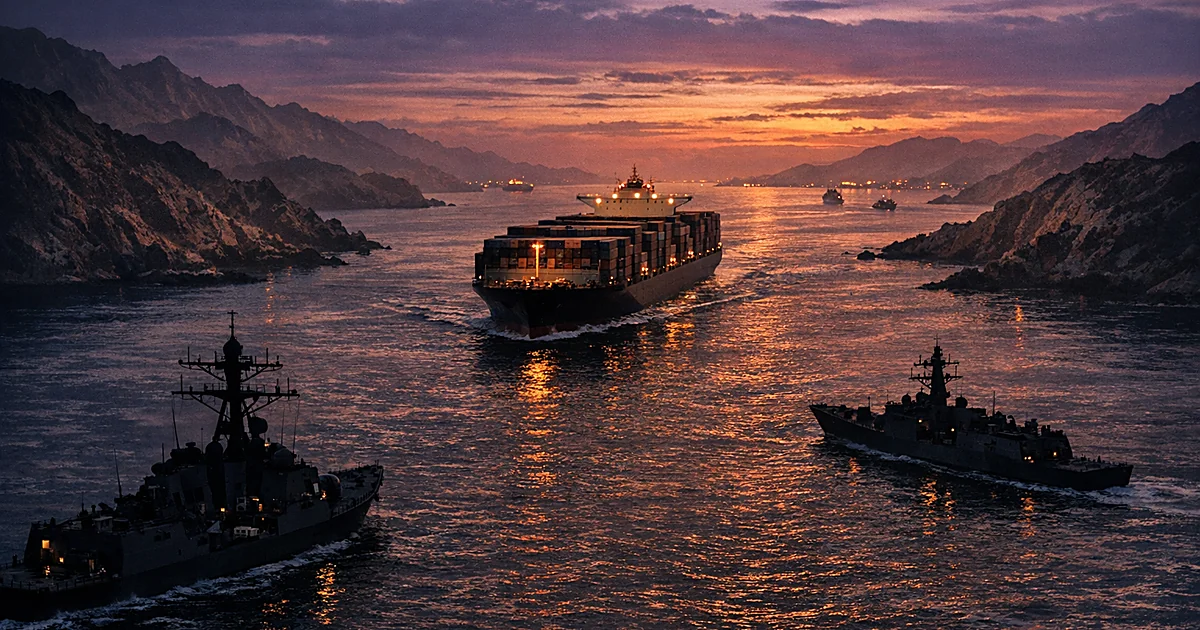
President Trump announced a 20% fee on all cargo passing through the Strait of Hormuz and ordered a renewed naval blockade of Iranian ports, triggering immediate market shocks, military moves, and a chorus of legal and diplomatic objections.
President Donald Trump made the declaration public via Truth Social, coupling the tariff with a pledge to reimpose a naval blockade of Iranian ports and to assert U.S. control over the waterway. “The U.S.A. will be, from this point forward, known as ‘THE GUARDIAN OF THE HORMUZ STRAIT,'” Trump wrote, adding that the country would be “reimbursed, at the rate of 20% on all cargo shipped, for any and all costs necessary to do the job of providing safety and security to this very volatile section of the World.”
The news hit global markets hard: oil prices jumped while stock indexes tumbled, and U.S. Central Command confirmed via a post on X that the blockade of Iranian ports would resume Tuesday at 4 p.m. ET. The White House briefing that followed left little doubt the administration intends to follow through on both the naval posture and the new fee structure.
“We’re attacking them tonight, and we’re taking out all of their capability for anything having to do with the strait,” Trump told reporters Monday afternoon. “And I think in the end, we will end up controlling the whole thing.”
The move reversed a mid-June 60-day ceasefire that had explicitly barred Tehran from imposing charges on commercial ships. Trump had signaled the possibility earlier on Truth Social, warning that tolls might be imposed “by and for the United States of America, should the deal not be completed, for services rendered as the Guardian Angel to the countries of the Middle East for purposes of both past, present, and future reimbursement of costs.”
Recent filings show new U.S. military action began July 7, and a July 10 notice to the Senate cited the War Powers Resolution. Congress passed a separate measure last month under the War Powers framework directing an end to hostilities in Iran, a move many described as “mostly symbolic” because it did not force an immediate military withdrawal.
The money at stake is huge. Before the conflict escalated, the Strait of Hormuz handled roughly 20% of the world’s oil trade, with pre-war shipping volumes estimated between $880 billion and $970 billion per year. A 20% toll on that traffic could generate between $176 billion and $194 billion annually, though wartime volumes are already far lower.
Tanker traffic through the strait had slowed dramatically during recent clashes, and benchmark oil prices climbed above $80 per barrel amid the hostilities. Ship counts dropped from pre-war averages of roughly 130 vessels per day to a single-digit trickle at times, illustrating how conflict can instantly choke commerce.
“We guarded it for nothing, and now we’re going to guard it, we’re going to get paid for guarding it. A lot of money.”
In interviews, the president made the fiscal case plain and added, “We can’t be expected to do that for nothing, unlike we had for many years.” Tehran pushed back fast, with Iranian officials insisting Iran, not the United States, controls the strait and that Tehran should be compensated for any protection duties.
“20% is of course too much. We will be fair.”
That Iranian response, which critiques the rate more than the concept, underscores how both sides view control and compensation as legitimate levers. U.S. officials, the International Maritime Organization, and other legal experts have pointed to long-standing rules that bar charging mandatory tolls on international waterways.
Secretary of State Marco Rubio said, “No country is allowed to charge tolls or fees on an international waterway. That’s existing international law.” The IMO stated it “stands firmly against charging fees for passage through straits used for international navigation” and added, “There is no legal basis through which to introduce mandatory tolls simply to transit through a strait.”
Legal critics argue the same framework that forbids Iran from imposing tolls would also appear to forbid the United States from doing so, and UN human rights specialists warned the plan could violate freedom-of-navigation principles. Still, some outside analysts dismissed the tariff as posturing.
“If the U.S. was able to safely escort ships and guarantee no threat from Iran, we would have seen that happen in the past few weeks. So I think this is really just bluster.”
Supporters counter that the policy is less about escorting ships than about asserting control, and the administration has paired the fee announcement with a sharp uptick in military action. The president ordered strikes on 80 Iranian targets after Tehran was accused of violating the ceasefire and claimed U.S. forces had degraded Iran’s navy, air force, missile capabilities, and drone manufacturing.
“If we didn’t do it, they would have had a nuclear weapon,” Trump said. “If they had a nuclear weapon, Israel would no longer be with us.” Those remarks frame the operation as strategic and preventive, not merely economic.
The United States appears to be operating in the strait without a European coalition, meaning American ships and firepower are bearing the immediate operational risk. Trump has repeated that he expects reimbursement, stating, “I want to be reimbursed because we’re protecting a very rich portion of the world.”
Past precedents, like U.S. protection of Kuwaiti shipping during the Iran-Iraq War, involved escorting ships under fire but did not impose universal tolls on an international waterway. Key practical questions remain open: how a toll would be collected, who would enforce it, what legal authority the administration claims, and whether commercial shippers will reroute to avoid a combat zone.
Blockade operations are resuming and strikes are underway, and officials on all sides are staking out firm positions. The debate over legality, enforcement, and who should ultimately cover the cost of keeping contested sea lanes open is just beginning, and the rhetoric on both sides shows little sign of cooling.

