

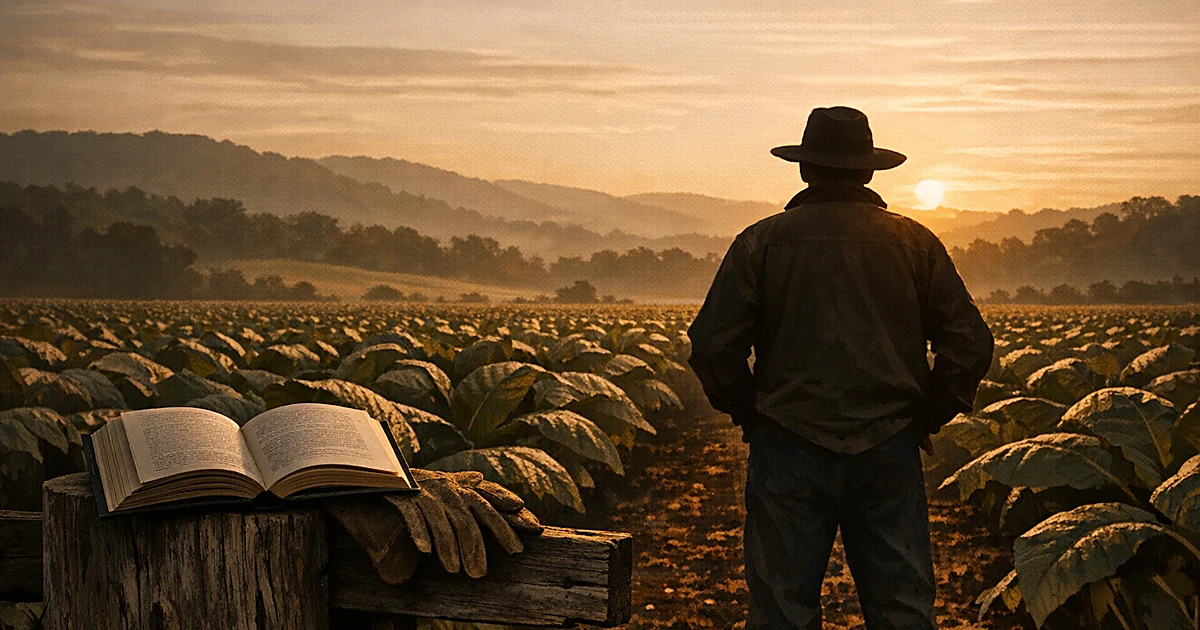
Wendell Berry, a Kentucky farmer and writer who spent decades defending small-scale agriculture, community, and honest stewardship of the land, died at 92, leaving more than 40 books and a reputation that earned respect across political lines.
Wendell Berry died Monday at his home in Port Royal; he was 92. His daughter Mary Berry confirmed his death to the Associated Press, and the family had not completed funeral arrangements when the news was shared. No cause of death was disclosed.
Berry was born in 1934 into a Henry County family that had farmed that ground since the era of the War of 1812. From that long view came his central argument: the soil matters more than the stock ticker, and communities rooted in place last longer than those built on consumption. His convictions drew praise from both sides of the political aisle because he refused neat labels.
His father, John Marshall Berry, co-founded the Burley Tobacco Growers Co-Op in the 1920s to protect small farmers from monopoly pricing. Family records note that a great-grandfather bought 500 acres in Henry County after Army service in the War of 1812, anchoring the family’s agrarian inheritance. Wendell Berry earned bachelor’s and master’s degrees in English from the University of Kentucky and won a Guggenheim Fellowship in 1961 that took him to France and Italy.
He worked in New York but chose to return to Kentucky for good in the 1960s, packing a Volkswagen Beetle and heading home. The decision came with what he described as “some fear and trembling, but also a sense of doing the right thing.” That move, he said, brought an unmistakable relief.
“I felt a great, deep relief, as if I was following, at last, my true path.”
Berry taught English at the University of Kentucky from 1964 to 1977 and again from 1987 to 1993, while also holding posts at Stanford, Georgetown College, New York University, the University of Cincinnati, and Bucknell. Through all the academic posts, the farm in Henry County remained his base of operations. He wrote novels, essays, and poetry from that home patch.
His nonfiction and verse returned to a handful of steady themes: ethical land use, the human cost of industrial agriculture, the duties neighbors owe one another, and a sense of God in the natural world. The National Endowment for the Humanities honored him in 2012 and called him “cheerful in dissent” and said he “pens to document and defend what is being lost to the forces of modernization and to explain how he lives and what he thinks.” Those lines capture the moral clarity he aimed for.
Berry’s shelf of honors includes the 2010 National Humanities Medal, awarded by President Barack Obama, the T.S. Eliot Prize, the Aiken Taylor Award, and the Dayton Literary Peace Prize’s Richard C. Holbrooke Distinguished Achievement Award, among others. He published more than 40 books across genres and became a touchstone for writers and readers interested in rooted, practical thought. His writing influenced many who saw value in thrift, family, and local economies.
“Unexpectedly found a chronicler of the nobility found in good, honest work, and thrift, and affection for one’s family and neighbors and animals and the land that supports and nourishes all of the above.”
“I have often asserted that if my job were simply to broadcast the works of Wendell Berry to the world, I’d die a happy man.”
Berry belonged to a circle of Kentucky writers sometimes called the Fab Five and maintained friendships across a wide literary field. Educators such as the late bell hooks taught from his work and praised his treatment of race and community in books like The Hidden Wound. Those connections reinforced his role as both regional storyteller and national moral voice.
He acted on his convictions as well as wrote about them. In February 1968 he told the Messenger Inquirer that “peace is more important than victory” during the Vietnam War era, and he took part in protests that led to arrests. His 1979 trespass arrest during a demonstration against the Marble Hill Nuclear Power Plant in Indiana became part of the record of how far he was willing to push to be heard.
“People asked if I wanted to be arrested and I said, ‘H*** No’ but I was willing to be.”
Berry later joined large demonstrations against the Capitol Power Plant in Washington, D.C., in 2009, explaining the choice with equal bluntness: “Somebody asked me if I wanted to get arrested. The answer is very brief: No. But I’m willing to get arrested. Nothing else is working.” His willingness to accept discomfort became part of his public persona. He also protested mountaintop-removal mining and other extractive practices that threatened local ecologies.
When coal interests donated $7 million to the University of Kentucky and a dorm was renamed “Wildcat Coal Lodge,” Berry removed his personal papers from the university’s collection in late 2009 in protest. He framed the move as a defense of institutional integrity and stewardship of land values.
“When the university accepted the gift from (the) coal industry in return for naming the basketball dormitory ‘Wildcat Coal Lodge,’ the university had sold an advertisement.”
“I was taught that taking care of land was one of the primary human responsibilities. In the long run, the top soil, the forests and the woodland of this state will be more valuable than the coal deposits.”
One of Berry’s last public fights centered on a 1934 fresco by Ann Rice O’Hanlon that hung on the University of Kentucky campus. After years of debate and a 2019 sit-in by the Black Student Advisory Council, university officials moved to cover and later remove the mural; Berry, at 86, joined a lawsuit to block removal. He defended the fresco as an artistic and historical work that belonged to Kentucky’s cultural patrimony.
In his court petition Berry called the fresco “a figurative representation of the history of Lexington and Central Kentucky” and praised O’Hanlon’s “artistic choices that abstract the essential truths of the art as opposed to mere representation.” He described it as “part of what makes the O’Hanlon Mural unique and a valuable piece of the cultural assets of Kentucky held in trust by the University” and noted the mural was one of roughly 42 frescos from that era.
As of January 2026 the Lexington Herald-Leader reported the mural remained in place on campus, and public records from the case offered mixed updates about the final legal outcome. The dispute illustrated how Berry moved from farm fields into legal fights to preserve what he saw as community memory. He treated art and land as related things worth defending.
Berry’s agricultural convictions grew from practical family experience, not academic abstraction. His father’s co-op work stabilized prices for small tobacco growers and provided a model of local self-help. The co-op was, his daughter said, focused on helping small farmers without creating a subsidy dependency.
“Was the only farm program that I know of that served the people it was supposed to serve, and that was small farmers. It was never a subsidy, it was a price support. It cost the government nothing.”
The family requested that, in lieu of flowers, supporters consider donations to The Berry Center, the nonprofit he helped found in 2011. The Berry Center continues to run farmer education programs, a cooperative to connect producers with markets, and a bookstore tied to regional agrarian ideas. Mary Berry offered a brief tribute: “There’s not enough I could say about him to do him justice.”
“Beware the machinery of longevity. When a man’s life is over the decent thing is for him to die. The forest does not withhold itself from death.”

