

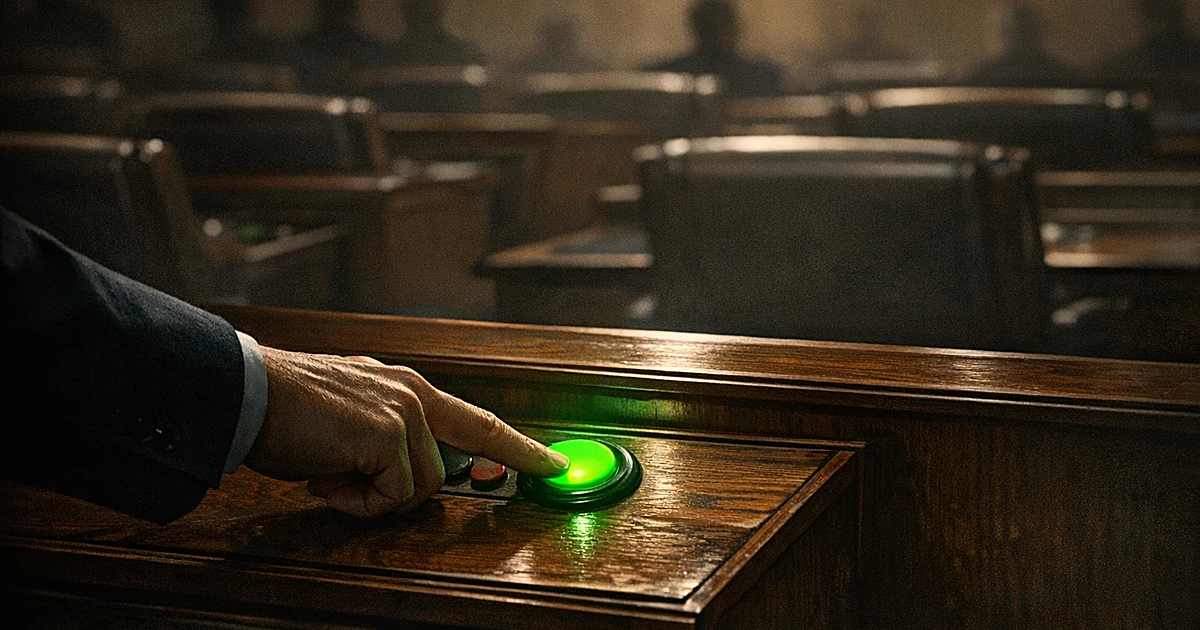
Sen. Bill Cassidy cast the decisive Republican vote to confirm Todd Blanche as attorney general, breaking a weeks-long standoff and handing Republicans a narrow 50-49 victory in the Senate.
On a Friday morning, Sen. Bill Cassidy announced he would vote yes after a phone call with Todd Blanche, ending a drawn-out fight that left the GOP majority stretched thin. His decision provided the single Republican vote needed after two GOP senators crossed the aisle, and it cleared the path for Blanche’s confirmation.
The vote came down to math more than enthusiasm. With Senate Minority Leader Mitch McConnell absent, the threshold dropped and every remaining Republican ballot mattered, making Cassidy the man in the middle who understood the choice before him.
Cassidy framed his decision as cold practicality rather than a glowing endorsement. He told colleagues on the floor that “is between Mr. Blanche and another acting attorney general who may not run the department effectively under President Trump, and who indeed may not be as good as Mr. Blanche.” That was the calculus he presented: pick the person likeliest to keep the Justice Department functioning.
He warned about the risks of leaving the department rudderless and spelled out the stakes. “This puts at risk the progress made fighting violent crime, human and drug trafficking, and fraud. And this does not serve the American people well.” The point was clear: public-safety priorities would suffer if the DOJ drifted without a Senate-confirmed leader.
Cassidy stressed his vote was narrow and issue-specific, not a blanket statement about the president. He said the vote “is not a referendum” on the president, adding: “It is a decision regarding Mr. Blanche in very specific circumstances. All considered, I will vote for Mr. Blanche.” He also acknowledged the political price: “I’ll be criticized for this vote. What’s new?” while insisting he worked to understand the matter for his constituents.
That political reality was sharp for Cassidy, who lost his seat earlier in the year after a Trump-backed challenger defeated him in the Republican primary. As an outgoing senator, he had less to lose politically, and he framed his yes vote as choosing a functional Justice Department over prolonged chaos.
The confirmation fight bent and shifted in committee first, where Blanche moved to withdraw an order tied to what critics called an Anti-Weaponization Fund. That concession was the negotiating move that brought skeptical Republicans back on board and cleared a path to advance the nomination.
Sens. John Cornyn and Thom Tillis said they would proceed after Blanche rescinded that order, a key condition for their support. As Cornyn put it plainly, “I think the DOJ needs Senate-confirmed leadership to prevent some of the chaos and dysfunction over there, and I think Blanche is as good as you’re going to get.” His tone was practical, not celebratory, and it captured the mood of Republicans balancing concerns against the need for stability.
Even with those votes, the margin remained brutally thin. Republicans technically control a 53-47 Senate, but defections by Sens. Susan Collins and Lisa Murkowski combined with McConnell’s absence to shrink the functional majority to a single vote. Vice President JD Vance would have been prepared to break a tie, but Cassidy’s yes made that unnecessary.
Democrats lined up against Blanche, and the two Republican holdouts announced their opposition before Cassidy spoke. The precise reasons Collins and Murkowski cited were not fully detailed publicly, leaving some unanswered questions about their objections and the political calculations behind them.
President Trump reportedly pushed hard behind the scenes and even floated withdrawing the nomination rather than see it fail, a pressure move aimed at moving holdouts. The timing mattered: confirming Blanche before the August recess avoided months with only acting leadership at the Justice Department.
After the vote, Blanche acknowledged the moment with stark gratitude. He said, “I am deeply honored by the trust and confidence President Trump has placed in me to lead the Department of Justice as our great nation’s 88th Attorney General.” Senator Chuck Grassley offered a terse endorsement: “Mr. Blanche is the right choice.” Those remarks closed one chapter of the fight and opened the next phase of governing.
Still, real questions linger about the undone details: the full scope of the rescinded order, the precise objections from the two defecting Republicans, and whether concessions made to win committee support will limit Blanche’s maneuvering as attorney general. With a 53-seat majority that can deliver a nominee only by a single vote, the lesson for Republicans is plain — unity and discipline are not optional when the margin is this thin.

