

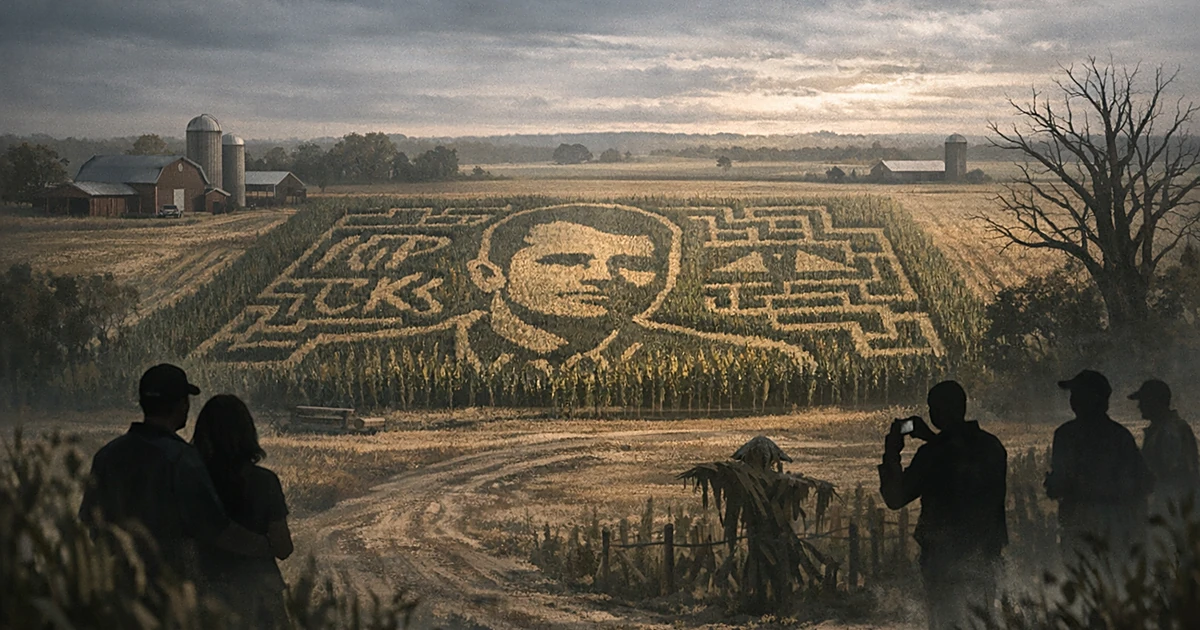
Goebel Farms drew sharp criticism after unveiling a 2026 corn maze featuring a portrait of Charlie Kirk, prompting debate over free speech, political violence and how communities respond to disagreement.
Goebel Farms in Evansville put a portrait of Charlie Kirk into its 2026 corn maze, including the inscription “RIP CK” and his death date, after he was shot at a Turning Point USA event at Utah Valley University in September 2025. The tribute sparked a wave of negative online reactions, with dozens of critical reviews and heated discussions on social media. The farm’s online listings reported disruptions tied to the backlash, and the decision quickly moved beyond a local curiosity into a broader public argument.
The farm issued a public statement to explain their choice and to push back against claims of partisanship. “Our intention was not to suggest that everyone should share Charlie’s beliefs or agree with every statement he made. We recognize that he was a polarizing public figure and that many people strongly disagreed with his views and methods. Charlie was killed while publicly expressing and debating his convictions.” The statement framed the tribute as a reaction to violence rather than a promotion of any single political platform.
Goebel Farms has stressed it is not taking a campaign position and pushed back on claims it meant to provoke. Their management made clear they are “not a political organization.” The farm also said, “no person should lose his or her life for participating in political discussion.” Those lines were used to explain why the image was chosen despite Kirk’s polarizing profile.
Beyond the official words, the farm offered a plea for continued civil engagement and listening. “Even when our disagreements are serious, we must continue talking and listening to one another. When conversation stops, division deepens, and it becomes easier to view people as enemies rather than neighbors.” That appeal to conversation over escalation was repeated as they prepared for the season and potential confrontations at the property.
Response to the maze has been mixed: criticism and calls for boycott arrived alongside notes of support and promises to visit. The farm’s Yelp and other listings reportedly took hits, but encouragement also appeared online and among visitors who framed their trips as support for debate without violence. Jeremy Goebel, the farm manager, said the maze was “meant to honor someone, not to tell anyone else they aren’t welcome.” Staff have been told to avoid political confrontations and the operation is reviewing security plans.
Many supporters cast the tribute as a plea against political violence and for robust public debate, turning a rural attraction into a flashpoint for national discussion. “Our hope remains simple: that Americans can speak openly, disagree honestly and challenge one another’s ideas without hatred or violence.” Those words were repeated by backers who argued that punishing a small business for a symbolic choice only deepens hostility.
The maze controversy sits against the backdrop of an active criminal case tied to Kirk’s death. Tyler Robinson, 23, has been charged with seven counts, including aggravated murder, felony discharge of a firearm causing serious bodily injury, obstruction of justice, witness tampering, and committing a violent offense in the presence of a child. A Utah judge ruled there is enough evidence for Robinson to stand trial, and prosecutors are pursuing the death penalty as an option, drawing national attention to the case and its legal stakes.
The killing and its aftermath have continued to provoke strong reactions on all sides, from calls for justice to moments of public mockery and outrage. Some public figures and commentators reacted in ways that amplified the bitterness around the episode, feeding the sense that political disagreement has become less about ideas and more about scoring personal blows. That context helps explain why a corn maze could ignite so much heated discussion.
The farm insists the tribute was a defense of free expression and a rejection of violent responses to ideas. “People are free to challenge ideas, criticize them and reject them, but violence must never become the response to speech.” Even as critics push back, the farm’s message calls for continued dialogue rather than retribution, and the debate over toleration, protest and consequences shows no sign of settling down.


2 Comments
His trying to explain things to people who have intention of listening because it disagrees with their agendas!
Charlie Kirk was not a polarizing figure. The word polarizing has been misused for many decades. An example is the following: 1. You are punched in the face, 2. You say, “Would you mind to not punch me in the face?” 3. You are said to be polarizing the situation. In this case it wasn’t just punching by such that use the term. This explanation will be called – any guesses?