

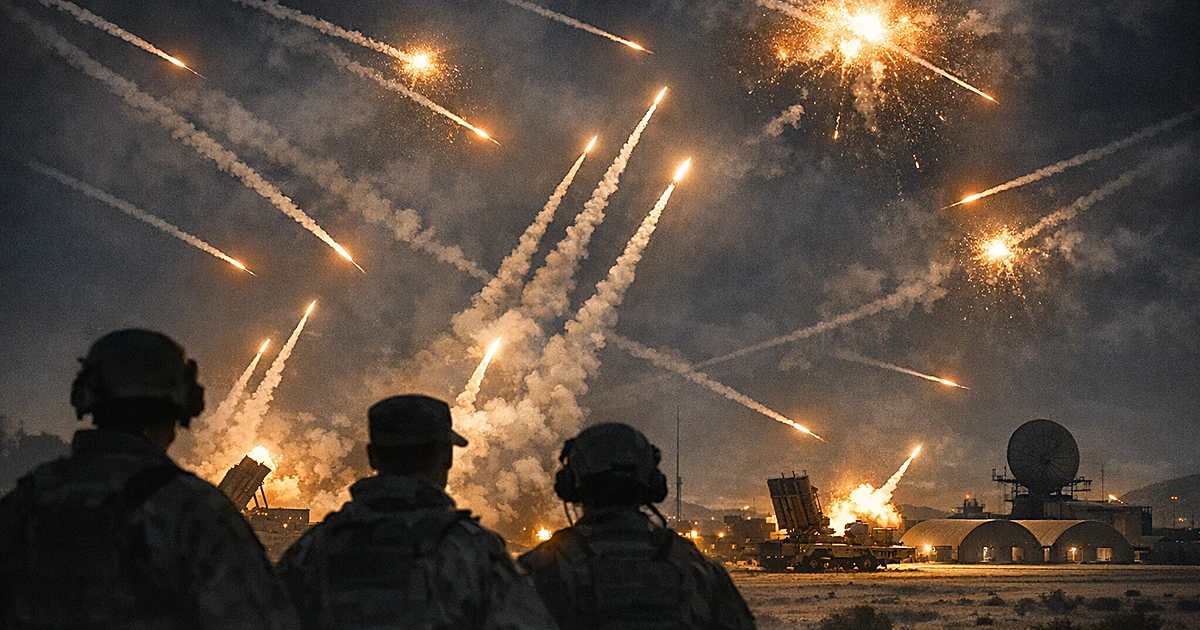
A rapid escalation in the Middle East after Iranian missiles struck American positions in Jordan led to swift U.S. and Saudi counterstrikes across Iraq, casualties among Iran-aligned forces, and renewed questions about Baghdad’s ability to control armed proxies, while both Tehran and Washington mixed military moves with diplomatic signaling.
Iran’s Islamic Revolutionary Guard Corps launched multiple ballistic missiles at Muwaffaq Salti Air Base and the U.S. Central Command headquarters in Jordan, and CENTCOM said the incoming missiles were intercepted. Jordan’s military reported it shot down five missiles with no casualties or material damage on the ground. The barrage ended a short ceasefire that had briefly opened space for talks.
President Trump reacted sharply and publicly within hours, leaving no doubt about the tone Washington would take. He warned of a forceful response and pressed the point that negotiation must follow strength. That blunt stance resonated with allies who want to see American deterrence restored quickly.
“We’ll be hitting them hard. They’re going to get a beating.”
Trump followed that with blunter language, telling Fox News: “We are going to beat the ‘effing s***’ out of them.” He also said Iran had at one point asked for a pause: “They asked us very nicely, Please stop, let’s meet.” The president has mixed clear warnings with an openness to talks, a strategy meant to undercut Tehran’s coercion.
Hours after the Jordan strike, U.S. and Saudi jets struck logistics and weapons sites tied to Iran-aligned militants across seven Iraqi provinces. The Hashed al-Shaabi reported at least 20 members killed and said Iranian advisors were among the dead, while coffins draped in Iranian flags were seen at some scenes. The Hashed called the strikes a “dangerous escalation” and Iraq’s leadership publicly rejected “all acts of aggression, regardless of the party responsible or the justifications presented.”
Iraq’s Ministerial Council for National Security insisted it would “confront any violation of Iraq’s sovereignty, and prevent any source from using Iraqi territory to threaten neighbouring states.” Yet Baghdad also allowed that the situation is complex, given pro-Iran factions are embedded in official security structures. Prime Minister al-Zaidi’s shuttle diplomacy to Washington and Tehran shows how strained Iraq’s balancing act has become.
The IRGC framed its Jordan attack as an operation to “liberate the Islamic land of Jordan” and claimed through state media to have killed “several” American officers and technical personnel and to have destroyed three F-35 jets at a Jordanian base. Jordanian officials contradicted those assertions, saying air defenses “engaged five missiles launched from Iran targeting the Kingdom’s territory early this morning. The missiles were detected, intercepted, and shot down according to established defense plans.” The Pentagon had not confirmed any U.S. casualties.
Analysts see Iran shifting from a reactive posture to deliberate escalation, using proxies to keep pressure on multiple fronts while engaging diplomacy. One regional analyst described Tehran’s approach as sustaining leverage through its networks as talks absorb international attention. That pattern forces Washington to defend forward positions and still keep diplomatic channels open.
Beyond missiles, Iran claims it seized control of parts of the Strait of Hormuz and said it stopped three tankers, asserting plans to collect transit fees. With roughly a fifth of global oil flows normally passing through Hormuz, any sustained blockage rattles markets and reroutes shipments toward the Red Sea. Saudi oil infrastructure and shipping lanes have become more exposed as Tehran and its proxies push to disrupt global supplies.
Drone and missile attacks have also hit Saudi facilities, and oil prices spiked amid the uncertainty. The conflict has now lasted more than 100 days, with repeated attacks on U.S. bases in the region and intermittent strikes by American and allied forces. These exchanges make clear that no single front is isolated and that escalation can spread quickly across borders.
Hezbollah added another layer of risk with a cross-border drone incident in Lebanon, which Israeli forces called a violation of an earlier ceasefire. The episode underlined how Iran’s proxy network operates in concert, pressuring multiple neighbors and stretching regional responses. Each flare-up raises the danger of a wider clash between established militaries and proxy forces.
CENTCOM reported strikes on dozens of IRGC-related targets aimed at degrading command, missile, drone, and maritime capabilities. Tehran’s foreign ministry said, “Following overnight events, we need to re-assess the diplomatic path with Washington… any diplomatic process requires a minimum stable environment.” Both sides continue to mix force with signals toward negotiation, but actions on the ground will determine whether diplomacy can proceed from a position of strength.
President Trump has used blunt messaging alongside military action, posting earlier on Truth Social: “Iran is all talk and no action. The Bully of the Middle East is DEAD!!! They’ve taken too long to negotiate a deal that would have been great for them, now they will have to pay the price!!!” That tone reflects a Republican argument for hitting back first and letting talks follow when leverage is restored. The coming days will show if that approach compels Tehran to change course or simply prolongs the cycle of escalation.

