

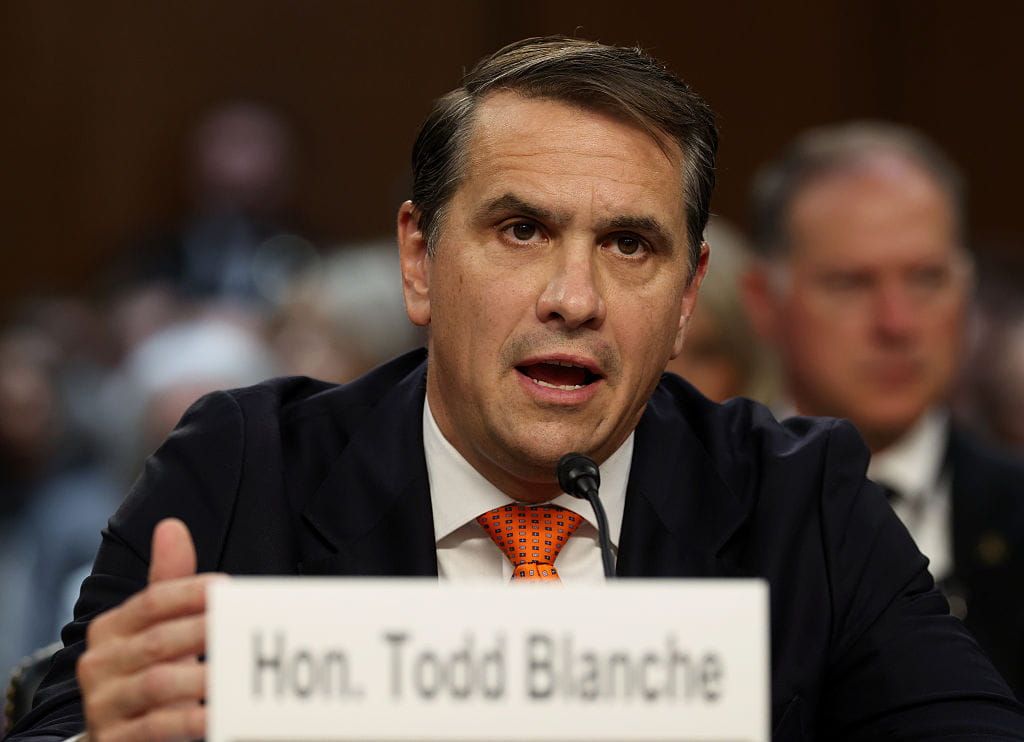
A tense showdown over Todd Blanche’s rise at the Department of Justice has turned into a test of President Trump’s influence with Senate Republicans, as holdout senators demand guarantees and the White House weighs pulling a nomination to wait out their departures.
The fight over Deputy Attorney General Todd Blanche has become a raw measure of power inside the Republican coalition. Blanche, nominated to lead the Department of Justice on June 8 after serving as acting AG since April 2, is at the center of a standoff that reaches beyond one personnel fight and into how much a president can, and should, expect his party to back him.
Blanche’s history as Donald Trump’s personal lawyer during the 2023 litigation season — when Trump faced classified documents charges in Florida, obstruction charges in DC, and a hush-money trial in New York — has made some senators wary. He was confirmed as deputy AG in March 2025 by a party-line vote of 52 to 46, with just one Democrat and one Republican not voting, but his elevation to full Attorney General has run into unexpected resistance.
Some of Blanche’s early decisions as acting AG widened those divides almost immediately. On May 18 he signed an order creating the $1.776 billion “Anti-Weaponization Fund,” intended to compensate people who claim they were targeted by retaliatory prosecutions, and he moved to settle a DOJ case involving the IRS and the president. A day later he issued an order barring the IRS from auditing the Trump family and its businesses, moves that fueled criticism across the aisle and skepticism inside it.
Those decisions complicated broader Republican priorities in Congress. What began as momentum toward a $72 billion reconciliation package to fund ICE and CBP stalled as GOP unity frayed, and leaders pulled back before Memorial Day. The fund was later shelved, but the hard feelings remained, feeding suspicion about priorities and power inside the party.
Today the nomination sits in the Senate Judiciary Committee, where a 12-10 Republican majority is effectively neutralized while two GOP senators withhold support. Tom Tillis of North Carolina and John Cornyn of Texas have made clear they want assurances that the fund is dead and that no blanket immunity will shield the president’s family from audits before they back Blanche.
President Trump has been blunt about the political dynamics. He said regarding Sen. Cornyn at a Cabinet meeting at Camp David on Friday, July 31, “This is being done by a senator, and I don’t really blame him to be honest with you. I endorsed his opponent,” and added, “The man that lost, the man that I didn’t endorse, has become very angry, and that’s OK.” He went on, “I mean, I understand that,” he continued. “I probably would do the same thing.”
Cornyn has also spoken plainly about his stance: “I think I am prepared to vote no, but I do think I owe it to my constituents and to Mr. Blanche to try to negotiate in good faith,” Cornyn told reporters Thursday. Both Cornyn and Tillis sit on the Judiciary Committee, and their refusal to back Blanche means the committee cannot send a favorable recommendation to the Senate floor under current math.
The White House response has been strategic rather than panicked. One lever is to withdraw Blanche’s nomination and let him continue as acting AG until the 120th Congress arrives. Cornyn was defeated in his primary by Texas Attorney General Ken Paxton, whom Trump did endorse, and Tillis announced his retirement, so both senators will be gone when the new Congress convenes in January. That timing has prompted talk of a calculated pause rather than a public bruising during a lame-duck session.
Legal mechanics favor the administration in certain ways. The Federal Vacancies Reform Act sets a 210-day limit on acting service, which from an April vacancy would run toward late October or November, but that clock pauses while a nomination is pending. Separately, the Attorney General Succession Act allows a confirmed deputy to exercise the duties of the office without a strict time cap, giving Blanche practical staying power as acting AG.
No plan is risk-free. Leaving the nomination on the table could invite Democrats to force a quick vote and engineer a public rejection, something the White House wants to avoid. Pulling the nomination to resubmit it in January is a power play aimed at two senators who soon will not be in position to block it, and it sends a clear message about presidential leverage: You aren’t as important as you think you are, and I don’t need your permission.
Republicans in the Senate now face a choice about party discipline and national strategy. The Blanche fight is less about one man’s fitness and more about whether a president will tolerate intraparty roadblocks or use timing and statutes to force the issue. How the GOP responds will shape not just the DOJ’s leadership but the baseline of authority between a Republican White House and its congressional allies.

