

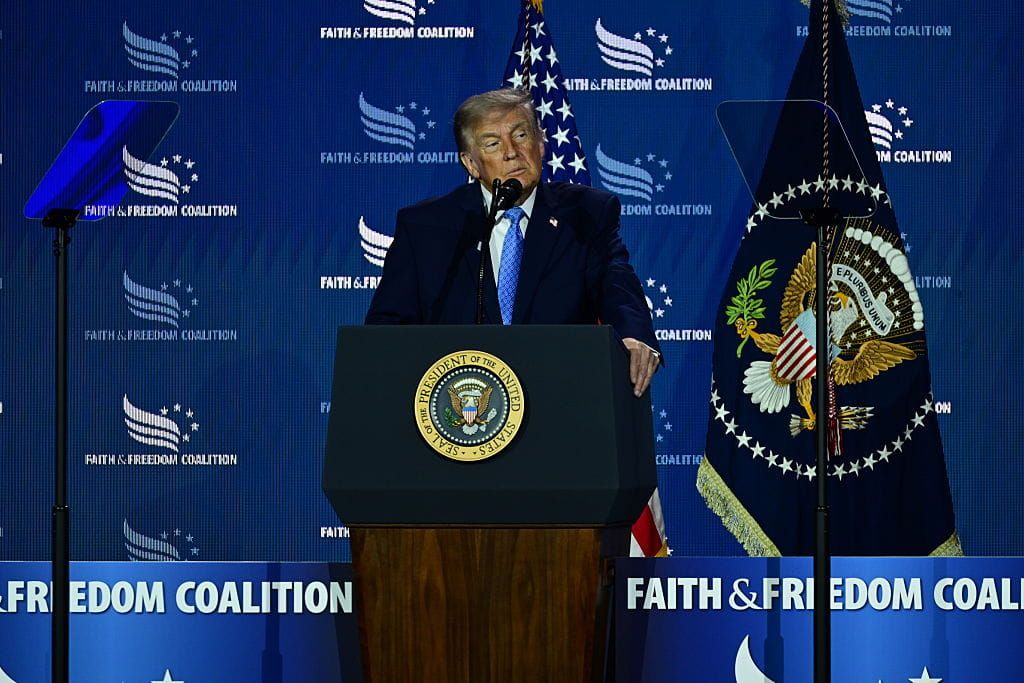
At the Faith and Freedom Coalition’s Road to Majority Conference on Jun 26, 2026, President Trump delivered a direct address defending core national symbols and warning about ideological threats, stressing the need for voters to support candidates who will defend faith, the Constitution, and American institutions.
President Trump spoke plainly to a crowd gathered at the Faith and Freedom Coalition event, framing the moment as a crossroads for the country. He reiterated the enduring role of faith in public life and argued that national symbols and mottos matter to civic cohesion. The remarks landed against the backdrop of intense political debate over cultural and economic direction.
One clear line from his address was a promise regarding the national motto: he said the United States will not change “In God We Trust,” and he linked that phrase to the identity of the nation. That declaration was presented as a defense of traditions many conservatives view as nonnegotiable, and it aimed to reassure voters who worry about rapid cultural shifts. The pledge was delivered with the bluntness his base expects.
Trump also targeted ideological rivals, calling communism a “cancer,” and using strong language to describe what he called the real-world consequences of leftist policies. He compared the effects of those systems with the outcomes of American free enterprise and individual liberty, urging attendees to remember recent history when casting ballots. The remark was meant to sharpen the contrast between the platforms on offer this election cycle.
The president pressed the audience to translate belief into votes, arguing that elections are the practical way to protect freedoms and institutions. He urged Republicans to show up in November as a decisive force capable of reversing policies he painted as harmful to families, churches, and small businesses. That practical emphasis—on turnout rather than nuance—was the core of his appeal to the activist crowd.
Audience response was energetic, with frequent applause and chants that underlined the atmosphere of a movement event rather than a policy briefing. The Road to Majority Conference has become a gathering point for conservative leaders who want to fuse faith-based arguments with a clear political strategy. For many attendees, the combination of cultural conviction and electoral calculation is precisely the point of these annual meetings.
While the speech leaned heavily on cultural themes, Trump also touched on policy implications, arguing that electing staunch conservatives matters for judicial appointments, school choice, and border security. He tied those policy goals to the broader insistence that American institutions must be preserved against what he described as radical alternatives. The message was that cultural preservation and policy wins are two sides of the same effort.
The conference continued to serve as a platform for aligning pastors, activists, and elected officials around a unified electoral strategy, and Trump’s remarks were positioned to sharpen that alignment. With less than a full campaign cycle to go before the critical November contests, the talk focused on momentum and mobilization rather than debate over tactics. Attendees left with a clear sense of urgency, and organizers signaled more events on the calendar to keep the energy moving forward.

